UX Case Study · 2025

Designing a local food pickup system along Atlanta's BeltLine.

Fresh Flow is a pilot platform connecting Georgia farmers and eco-friendly vendors with local shoppers through refrigerated kiosks, autonomous EV delivery, and a transparent, farmer-first logistics network.

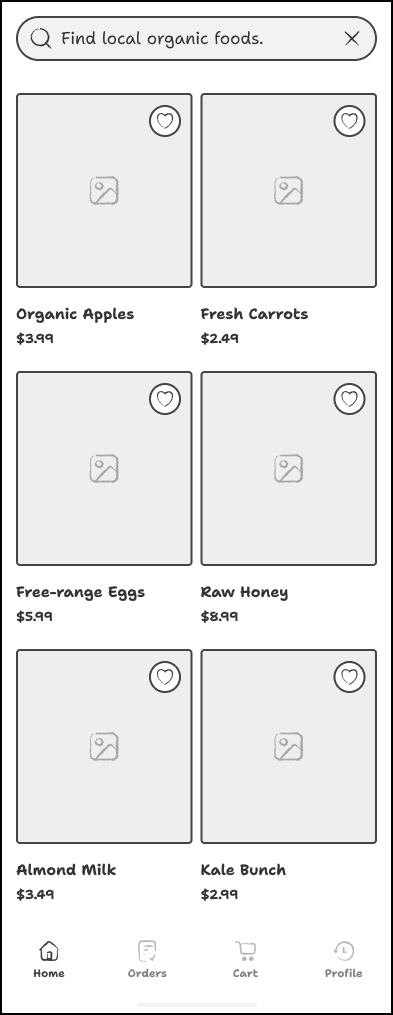
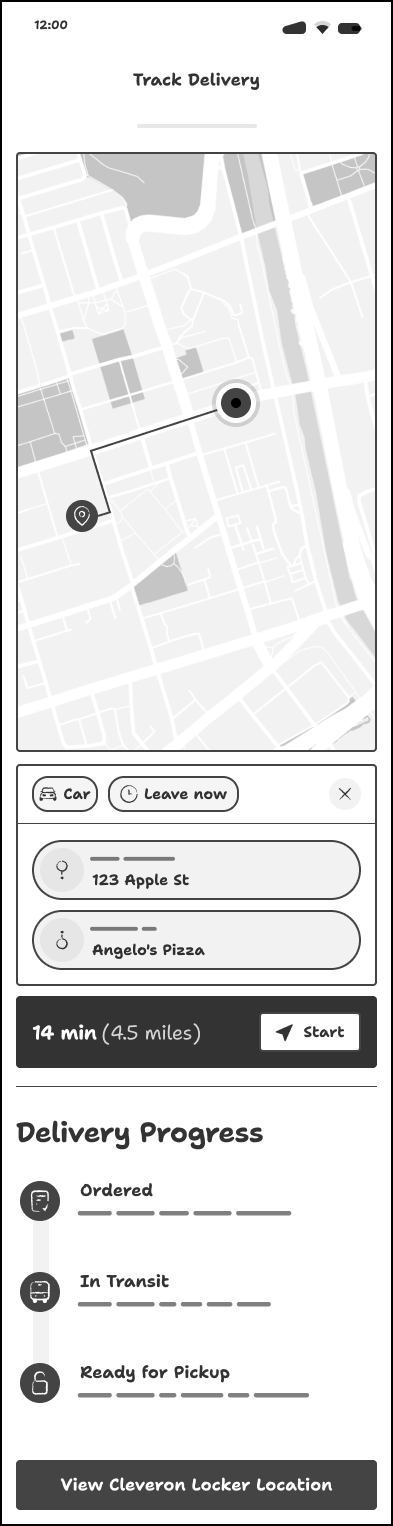
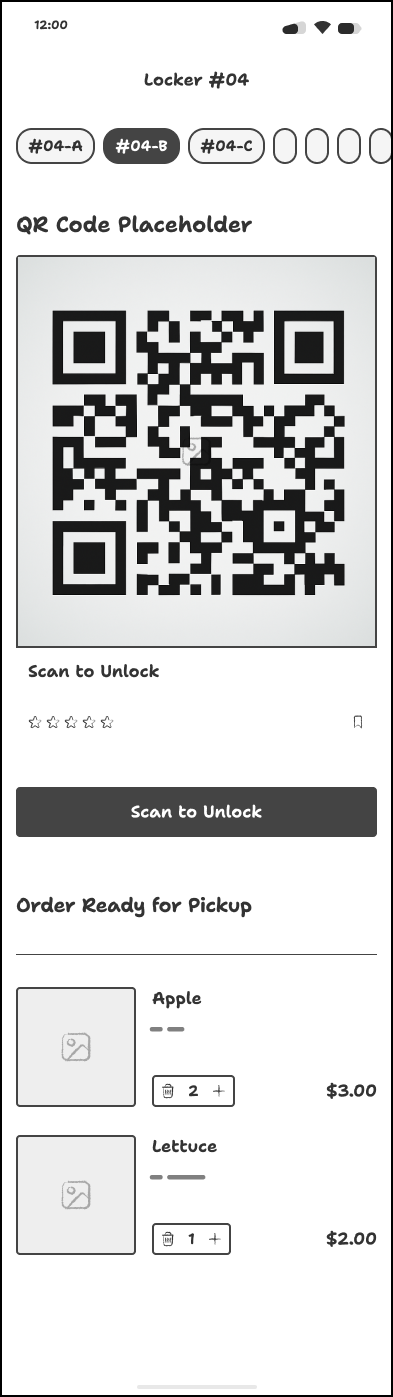
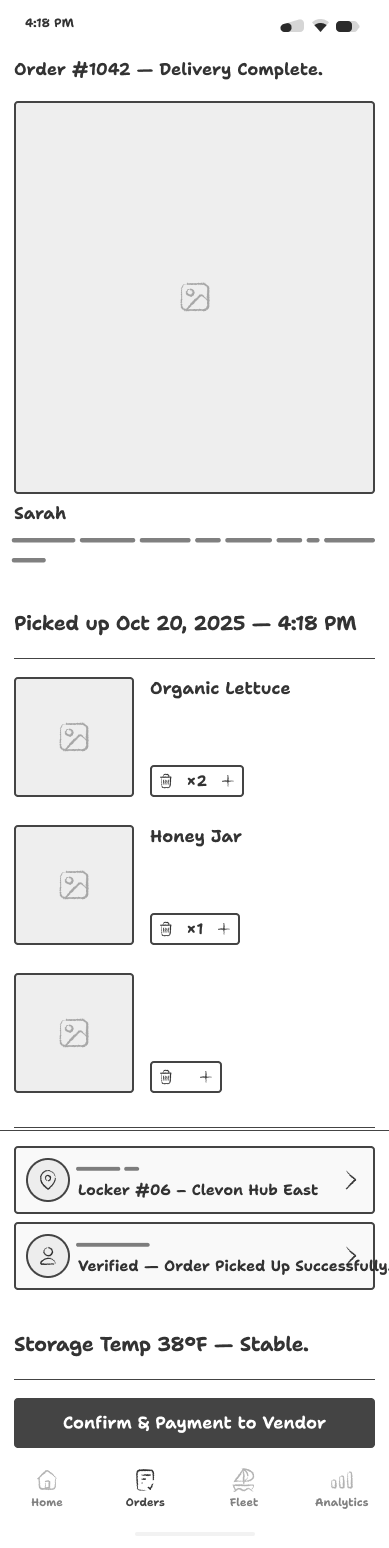
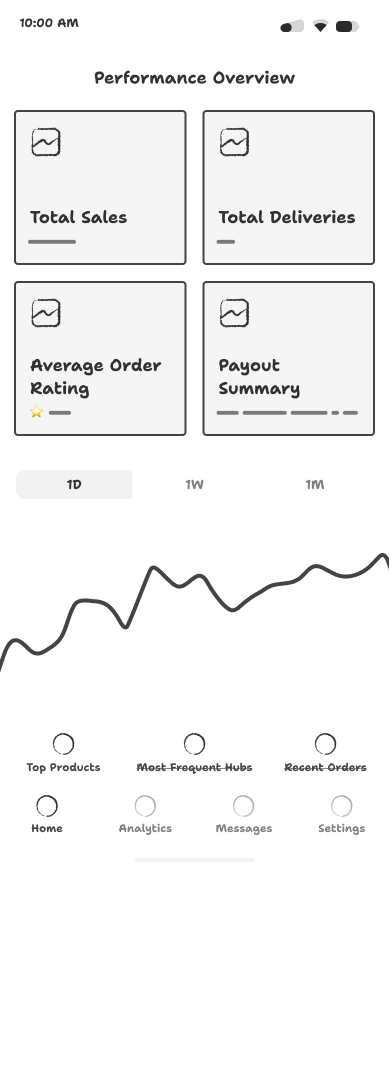
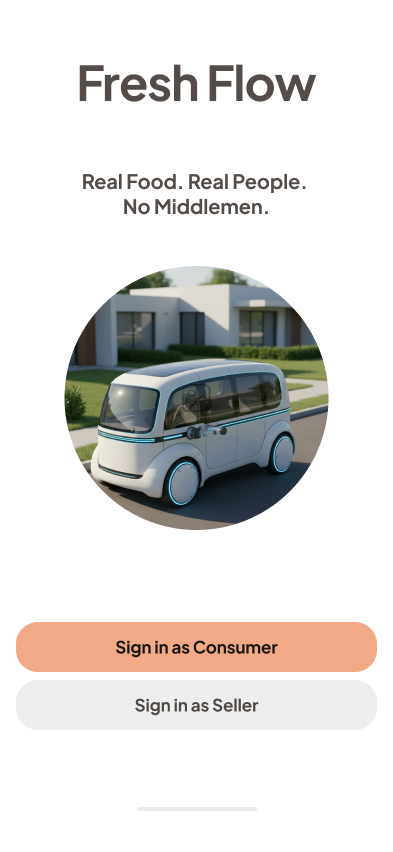
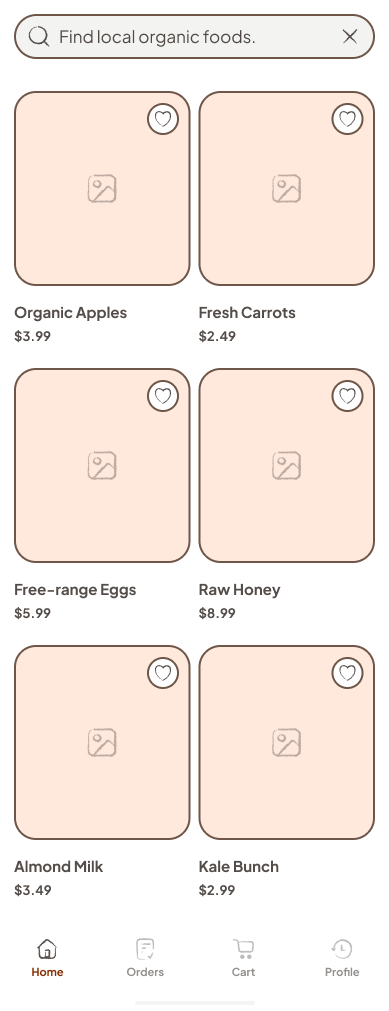
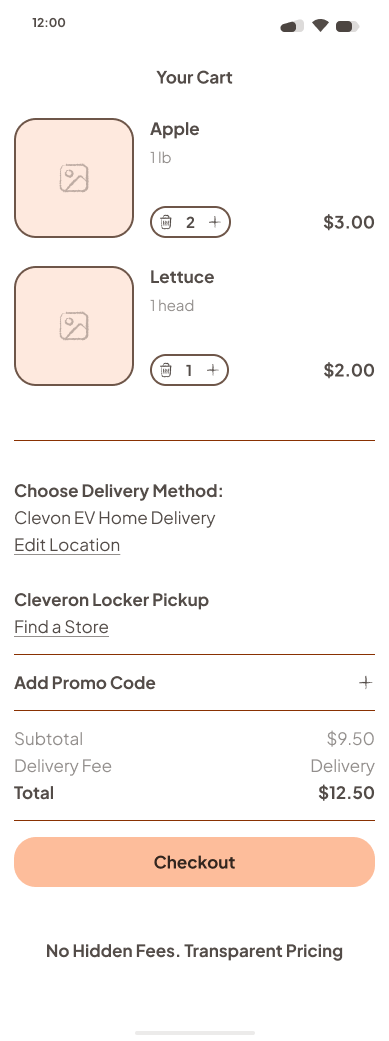
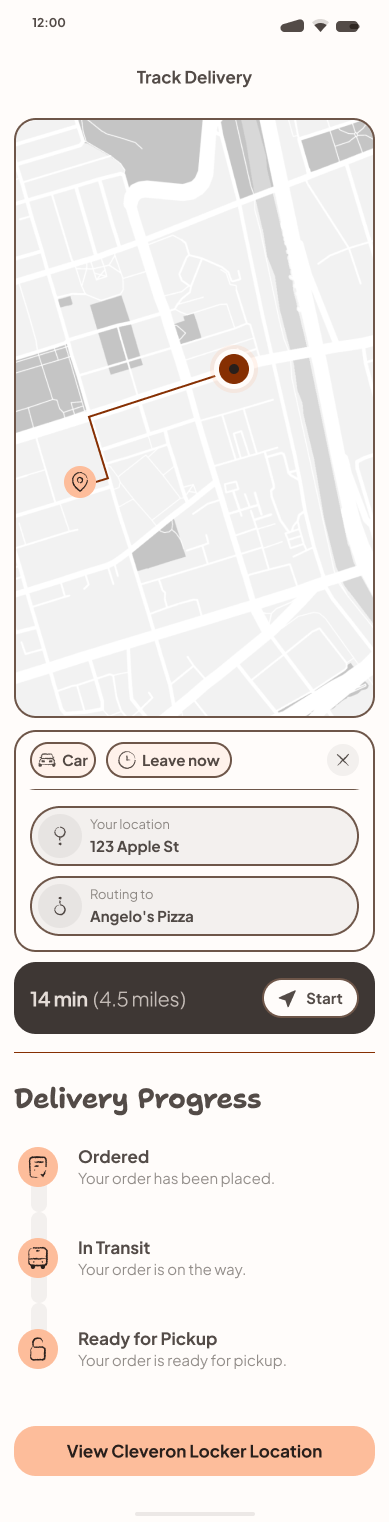
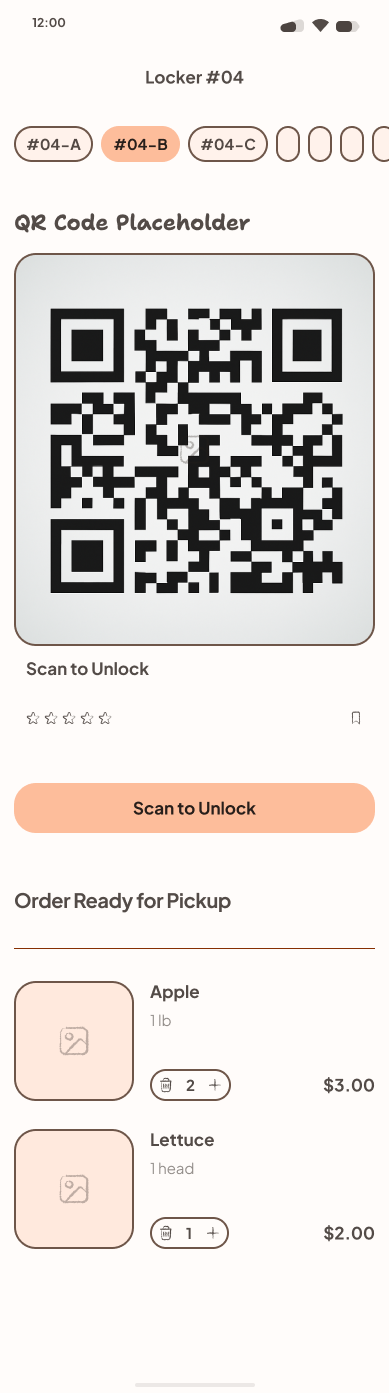
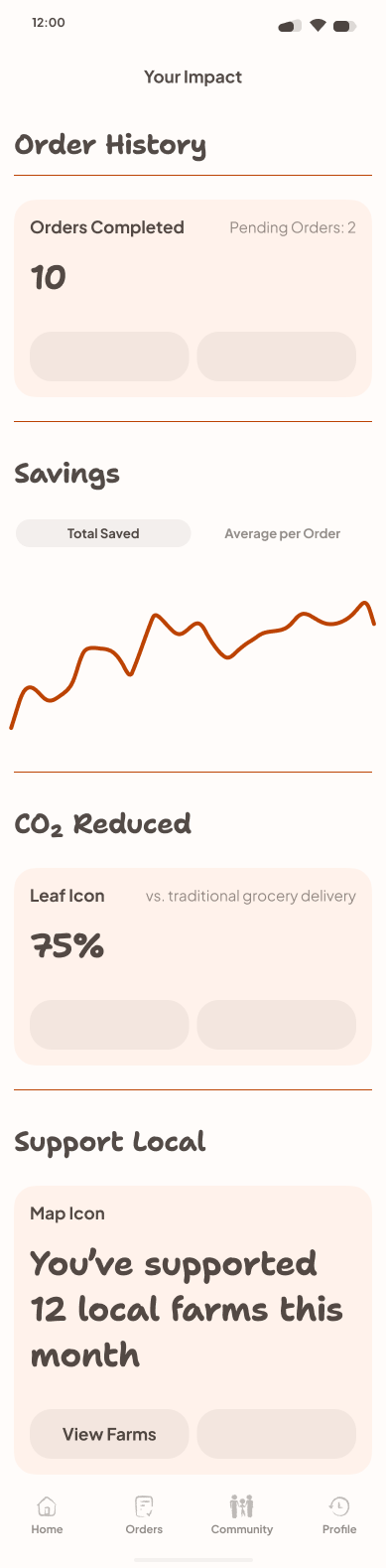
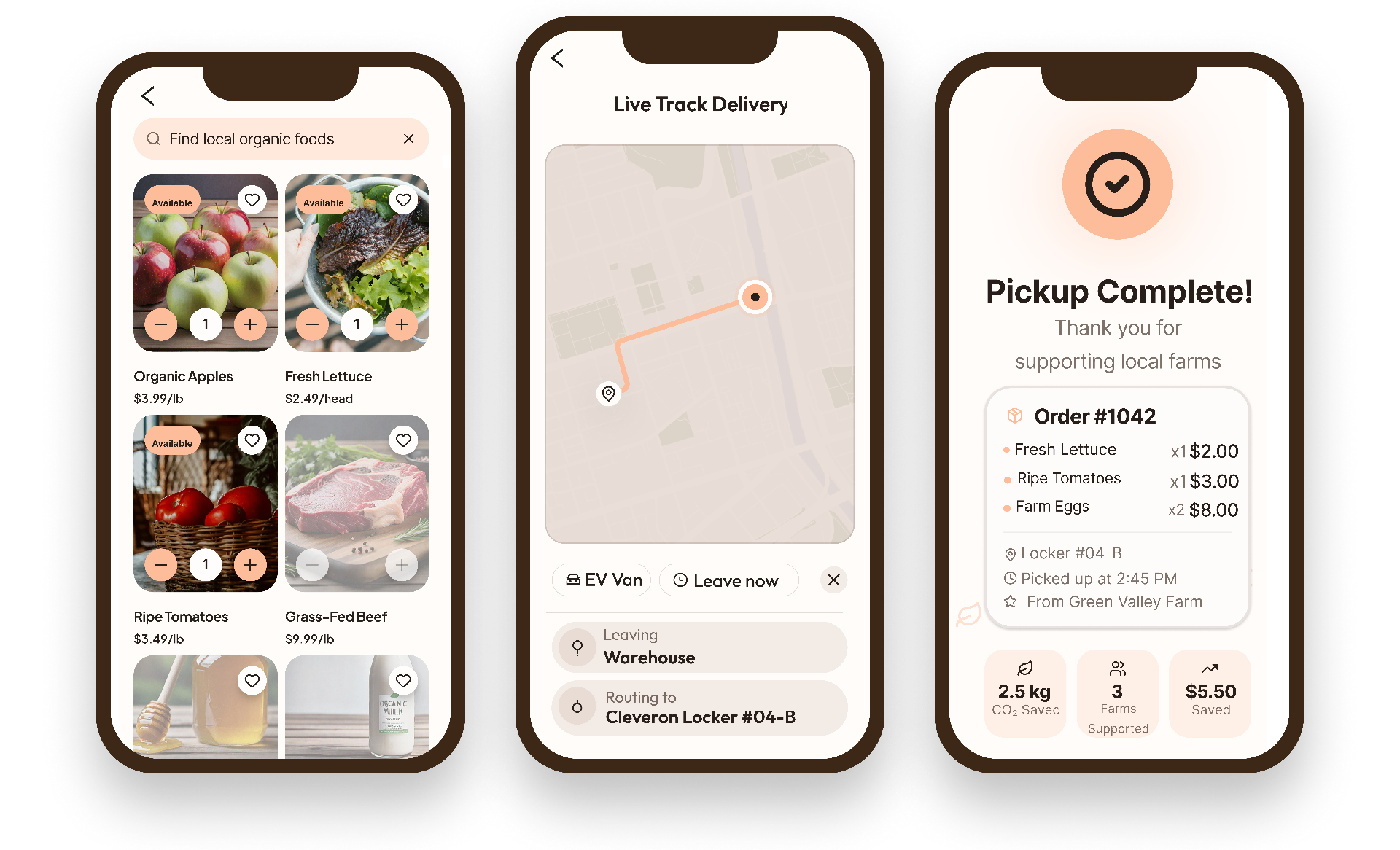
Fresh Flow iPhone mockups — browse local organic foods, live track delivery, and pickup complete screens

Executive Summary

Role

UX Research · UX/UI Design · Service Design · Branding

Timeline

Aug — Dec 2025

Platform

iOS & Android

Status

Patent Pending

Tools

Figma · FigJam · Adobe Creative Suite

Methods
User InterviewsAffinity MappingJourney MappingCompetitive AnalysisPersonasWireframingPrototypingUsability TestingService Blueprinting
Outcome

A human-centered service ecosystem connecting Georgia farmers, local businesses, and consumers through research-driven product and service design.

5
Research Participants
3
Research Phases
4
Opportunity Areas
1
End-to-End Experience

Introduction

From improving grocery shopping to rethinking local food systems.

What started as a study of grocery shopping evolved into something larger. Recurring patterns pointed past individual behavior to the systems around it — how food moves, who it reaches, and where trust breaks down.

THE RESEARCH CHALLENGE

How can we better understand the grocery shopping experience before designing a solution?

Before designing anything, I needed to see the experience the way shoppers actually live it. Discovery research surfaced the behaviors, motivations, and friction points that would ground every decision that followed.

Research Methods

Generative Interviews Affinity Mapping Journey Mapping Secondary Research

Discovery Phase

Planning the research before conducting interviews.

Before interviewing participants, I first participated in a collaborative research exercise to map the grocery shopping workflow from beginning to end. Rather than immediately interviewing users, I documented each stage of the experience to understand the overall process, identify assumptions, uncover knowledge gaps, and recognize decision points that required further investigation.

While reviewing the workflow, I realized grocery shopping was not a single universal journey. People's transportation, shopping environments, budgets, schedules, and personal circumstances significantly influenced how they planned, purchased, and received groceries. These observations became the foundation for developing focused research questions used during the generative interview phase.
Research Participants

Who informed the research.

Five generative interviews across different shopping behaviors, transportation situations, and lifestyles. Their stories shaped every artifact that follows — personas, journey map, affinity map, and opportunity areas.
Gia, Delivery-First Shopper
Gia
Delivery-First Shopper

Relies on grocery delivery

Jayne, Delivery-First Shopper
Jayne
Delivery-First Shopper

Relies on grocery delivery

Shannon, Multi-Store Shopper
Shannon
Multi-Store Shopper

Compares prices across stores

Teairis, Shopper Without a Car
Teairis
Shopper Without a Car

Walks or uses rideshare

Sean, In-Store Shopper
Sean
In-Store Shopper

Shops in-store for fresh produce

Research Snapshot
5Generative Interviews
Multiple Grocery Shopping Behaviors Represented
Research Informed Synthesis, Journey Mapping, and Opportunity Discovery

Current State Journey

Understanding the Grocery Shopping Journey Before Fresh Flow

Using insights synthesized from five generative interviews, I mapped the current grocery shopping experience to understand how shoppers planned, navigated, purchased, and received groceries. Rather than documenting individual behaviors, this journey highlights recurring patterns that consistently appeared across participants and exposed opportunities for innovation.
Stage 01
Discover
Stage 02
Plan
Stage 03
Shop
Stage 04
Checkout
Stage 05
Delivery / Transit
Stage 06
Receive
Stage 07
Reflect
Shopper Goal

Understand what meals to make and what groceries are needed.

Shopper Goal

Build a grocery plan around budget, transportation, and household needs.

Shopper Goal

Find quality items across the stores that fit each household's needs.

Shopper Goal

Pay confidently and confirm what is actually coming home.

Shopper Goal

Get groceries home cold, intact, and on time.

Shopper Goal

Verify freshness and put groceries away.

Shopper Goal

Decide what to repeat, replace, or rethink next week.

Common Behaviors
  • Check pantry
  • Browse recipes
  • Look for deals
  • Think about transportation
Common Behaviors
  • Compare stores
  • Make grocery lists
  • Decide delivery vs in-store
  • Coordinate errands
Common Behaviors
  • Visit multiple stores
  • Inspect produce
  • Substitute brands
  • Adjust to stock
Common Behaviors
  • Review totals
  • Apply rewards
  • Select handoff window
  • Approve substitutions
Common Behaviors
  • Track order
  • Wait for updates
  • Coordinate handoff
  • Manage temperature
Common Behaviors
  • Inspect bags
  • Check produce
  • Sort substitutions
  • Store away
Common Behaviors
  • Rate items
  • Save favorites
  • Adjust routines
  • Plan next trip
Observed Friction

Information is spread across multiple apps, memories, and store websites.

Observed Friction

No single place to compare freshness, pricing, and convenience.

Observed Friction

Participants frequently visited multiple stores because no single retailer met every need.

Observed Friction

Unexpected substitutions, fees, and inventory uncertainty reduced confidence.

Observed Friction

Low visibility after checkout created uncertainty around arrival time, handling, and product quality.

Observed Friction

Freshness and substitutions could only be evaluated after groceries arrived.

Observed Friction

Feedback rarely influenced future shopping experiences.

Design Opportunity

Centralize planning before shoppers begin making decisions.

Design Opportunity

Help shoppers evaluate trade-offs before leaving home.

Design Opportunity

Reduce the need to piece together a shopping trip across disconnected retailers.

Design Opportunity

Make trade-offs and costs visible before the order is finalized.

Design Opportunity

Provide transparency into how groceries are handled between purchase and arrival.

Design Opportunity

Move quality signals earlier in the shopping journey.

Design Opportunity

Close the loop so each shopping cycle informs the next.

Emotional Journey
CuriousHopefulFocusedFrustratedUncertainRelievedStill Adapting
RESEARCH SYNTHESIS

What the Journey Revealed

Realization 01

Grocery shopping wasn't a single journey.

Participants combined multiple stores, delivery services, transportation options, and budgets to meet their needs. Shopping was an adaptive process rather than a linear experience.

Realization 02

The biggest breakdown happened after checkout.

Trust declined whenever shoppers lost visibility into substitutions, freshness, food handling, or delivery status. Confidence depended on transparency.

Realization 03

Many challenges extended beyond the shopping experience.

Recurring concerns around sourcing, fulfillment, and transportation suggested the biggest pain points originated outside the customer-facing interface.

Realization 04

The research uncovered important knowledge gaps.

The interviews answered how people shop today but raised new questions about the systems behind food distribution. Those gaps became the focus of the next research phase.
KEY INSIGHT

The real opportunity was not redesigning checkout—it was redesigning the invisible infrastructure that connects farmers, fulfillment, and communities. This insight fundamentally changed the direction of the project.

Updated Problem Statement

A systems problem, not a shopping problem.

Round One interviews revealed that grocery shopping frustrations were symptoms of a much larger issue. While participants adapted to existing shopping tools, the systems behind sourcing, fulfillment, transparency, and local distribution remained fragmented. Rather than improving an individual shopping experience, the challenge became designing a transparent local food ecosystem that connects shoppers, farmers, producers, and logistics partners.
Design Sprint

Validating opportunities before designing solutions.

Rather than moving directly into ideation, I adapted the Design Sprint methodology to synthesize Round One research, identify knowledge gaps, and define what needed to be validated next. The sprint transformed research findings into focused questions that guided the next phase of discovery.

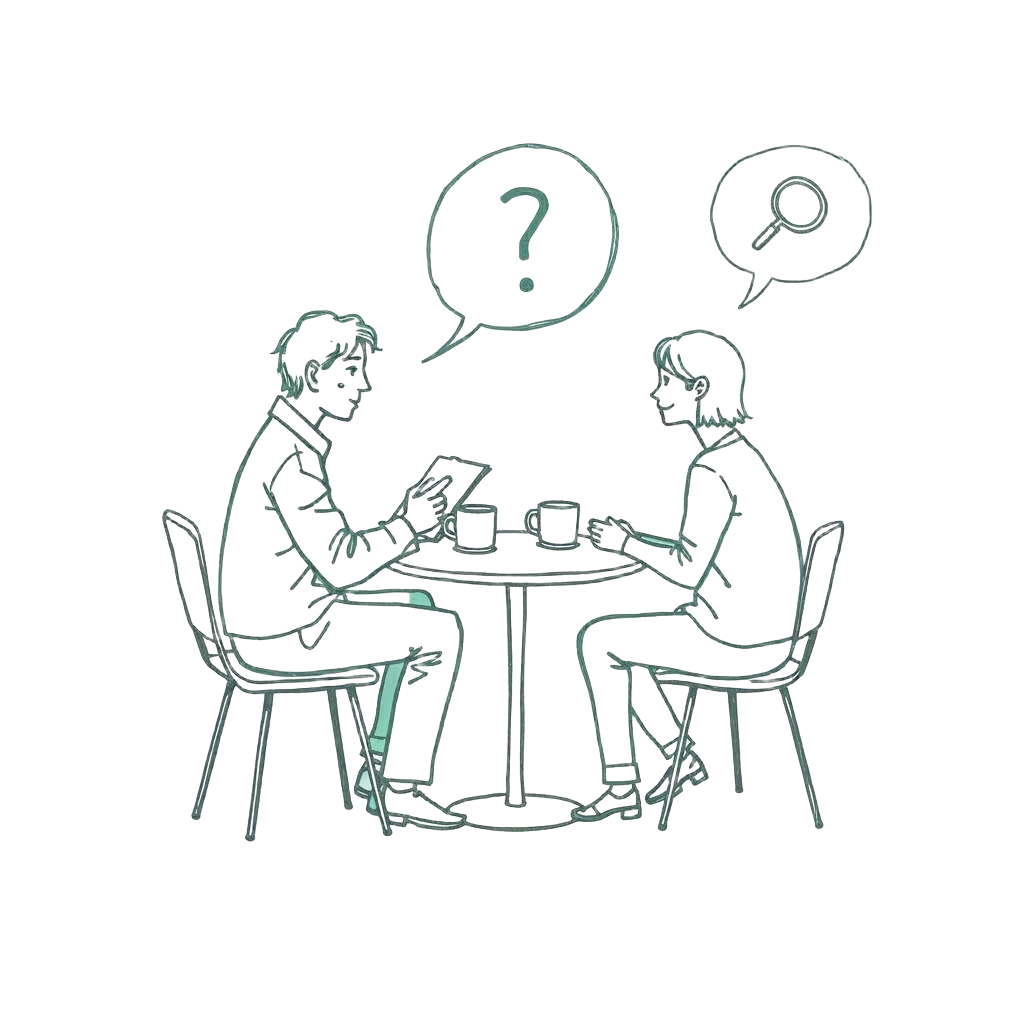
Ask the Experts

Validating the ecosystem through industry perspectives.

Secondary research strengthened the project's systems perspective, but important questions still remained. To validate these opportunities in practice, I expanded the research beyond shoppers and interviewed producers and logistics stakeholders. These conversations tested assumptions around fulfillment, transparency, sustainable distribution, and producer needs before moving into concept generation.

Hand-drawn sketch of two people in an expert interview

Research Validation Participants

Who validated the opportunity.

After refining the research through the Design Sprint, I conducted a second round of expert interviews to validate emerging opportunities. These conversations brought together perspectives from farming, local business, technology, and community advocacy to challenge assumptions before moving into ideation.

Keallah Smith, Farmer + Vendor
Keallah Smith
Farmer + Vendor
Amber Singleton, Senior Director, Operations
Amber Singleton
Senior Director, Operations
Shane Bingham, Community Advocate
Shane Bingham
Community Advocate
Sean Joseph, Senior Software Engineer
Sean Joseph
Senior Software Engineer
Research Snapshot
4Expert Interviews
Four Industry Perspectives
Validated Opportunities Before Ideation

Research Insights

What the experts revealed.

Across four expert interviews, four recurring patterns emerged. They pointed beyond individual features and toward the operating principles a transparent local food ecosystem would need.

Keallah Smith
Keallah Smith
Farmer + Vendor
Amber Singleton
Amber Singleton
Senior Director, Operations
Shane Bingham
Shane Bingham
Community Advocate
Sean Joseph
Sean Joseph
Senior Software Engineer
01

Transparency builds trust.

Experts consistently emphasized that visibility into sourcing, freshness, handling, and delivery is essential for building trust.

02

Technology should support people — not replace them.

Participants welcomed automation when it improved efficiency but expected human oversight for food quality, issue resolution, and accountability.

03

Supporting farmers strengthens the entire ecosystem.

Fair producer compensation, reliable logistics, and transparent operations were viewed as essential for creating long-term value across the ecosystem.

04

Community impact matters as much as convenience.

Beyond fast delivery, experts emphasized sustainability, local partnerships, education, and strengthening connections between communities and local producers.

Key Takeaway

Fresh Flow became more than a grocery platform.

Research confirmed the opportunity was designing a connected local food ecosystem that combines transparency, fulfillment, neighborhood access, and producer support.

Design Implications

  • Verified freshness and sourcing
  • Flexible pickup and delivery
  • Fair, transparent farmer payouts
  • Neighborhood community hubs
  • Human oversight of automation

Research Impact

How the research changed the project.

Expert interviews reframed the project from a shopping problem into an infrastructure opportunity. The comparison below shows how the direction shifted — and the four priorities that emerged as the foundation for the pivot.

Before Research

A better grocery shopping experience.

  • Better grocery shopping experience
  • Faster delivery
  • Better checkout
  • More convenience

After Expert Validation

A transparent, connected local food ecosystem.

  • Verified freshness
  • Transparent food systems
  • Protected farmers
  • Connected logistics
  • Community pickup infrastructure

New design priorities

01

Transparency first

Trust begins before purchase through sourcing, freshness verification, and handling visibility.

02

Support existing behaviors

Design around how people already combine stores, delivery, and pickup instead of forcing new habits.

03

Connected systems

The customer experience depends on producers, fulfillment, logistics, and community infrastructure working together.

04

Community infrastructure

Design beyond commerce — strengthen local food access, neighborhood hubs, and producer relationships.

The Shift

These findings fundamentally changed Fresh Flow from a grocery marketplace into a transparent local food ecosystem.

PROJECT PIVOT

Problem reframed through research.

Fresh Flow began as a grocery shopping experience. Research revealed the real opportunity was upstream — designing the infrastructure that supports trusted local food access.

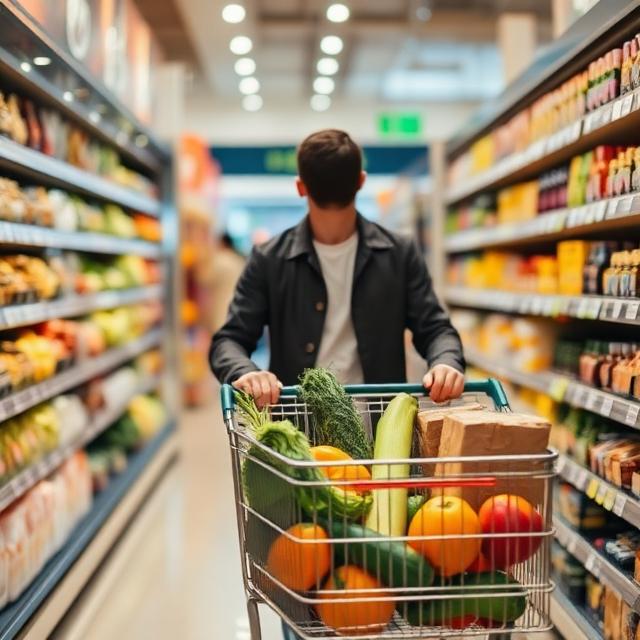
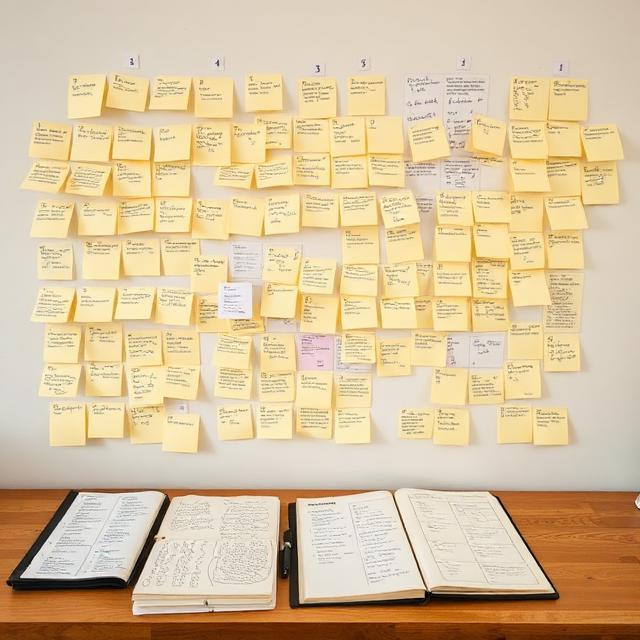
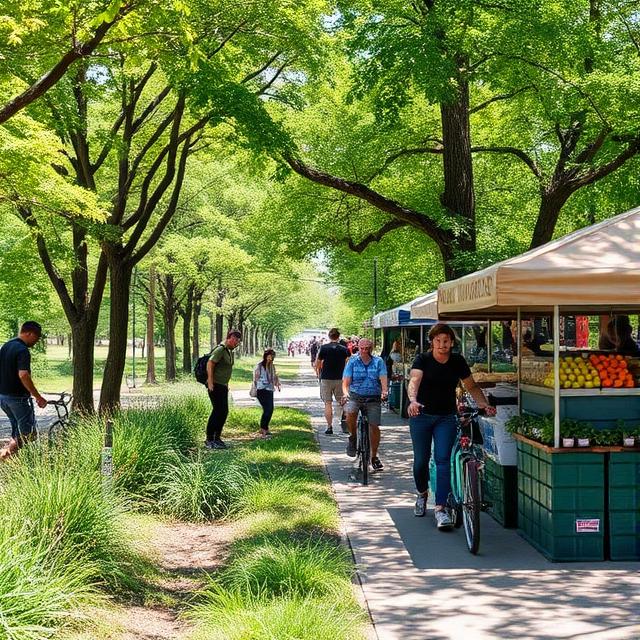
The diagram below shows the progression from the original shopping focus, through research synthesis, into the transparent local food ecosystem Fresh Flow became.

Original Focus

Person shopping for groceries in a supermarket aisle

Shopping Experience

  • Search
  • Checkout
  • Delivery
  • Convenience

Research Synthesis

Affinity mapping wall with sticky notes clustered into themes

Research
Synthesis

  • Interviews
  • Affinity Mapping
  • Journey Mapping
  • Secondary Research

LOCAL FOOD ECOSYSTEM

Atlanta BeltLine with local food vendors and community foot traffic

Transparent
Local Food
Ecosystem

Farmers

Vendors

Community Hubs

Pickup Network

Fulfillment

Logistics

Consumers

Design Questions

How Might We?

The research was translated into four design questions that guided concept exploration.
01

How might we make freshness, sourcing, and food handling visible before purchase?

02

How might we support flexible fulfillment through neighborhood pickup and autonomous delivery?

03

How might we protect farmers through transparent logistics and fair compensation?

04

How might we strengthen community connections while improving local food access?

Target Audience

Who Fresh Flow is designed for.

These personas are synthesized from the two research rounds. Each represents a different role in the local food ecosystem — with a distinct motivation and a distinct design need the product must serve.
Keallah — Farmer / Vendor
Keallah
Farmer / Vendor
"If I can trust how food is stored and handled, I'd love to reach more people locally."

Key insight: Producers need reliable, low-friction ways to reach nearby customers without giving up transparency or margin.

Design need: Transparent logistics and fair, visible farmer payouts.

Shane — Community Advocate
Shane
Community Advocate
"Farmers are the backbone — supporting them means a stronger city."

Key insight: Community stakeholders judge success by neighborhood impact, not just convenience metrics.

Design need: Neighborhood pickup hubs that visibly strengthen local food access.

Amber — Consumer
Amber
Consumer
"I want fresh food that's affordable and easy to access, not just convenient."

Key insight: Shoppers want proof of freshness and sourcing before they buy — not after.

Design need: Visible freshness, sourcing, and handling signals before checkout.

Sean — Technology & Operations
Sean
Technology & Operations
"If we track freshness and delivery with EV tech, the system could really work."

Key insight: The ecosystem only holds together when fulfillment, logistics, and pickup are one connected system.

Design need: Flexible fulfillment — neighborhood pickup and autonomous delivery — under one operational layer.

Concept Exploration

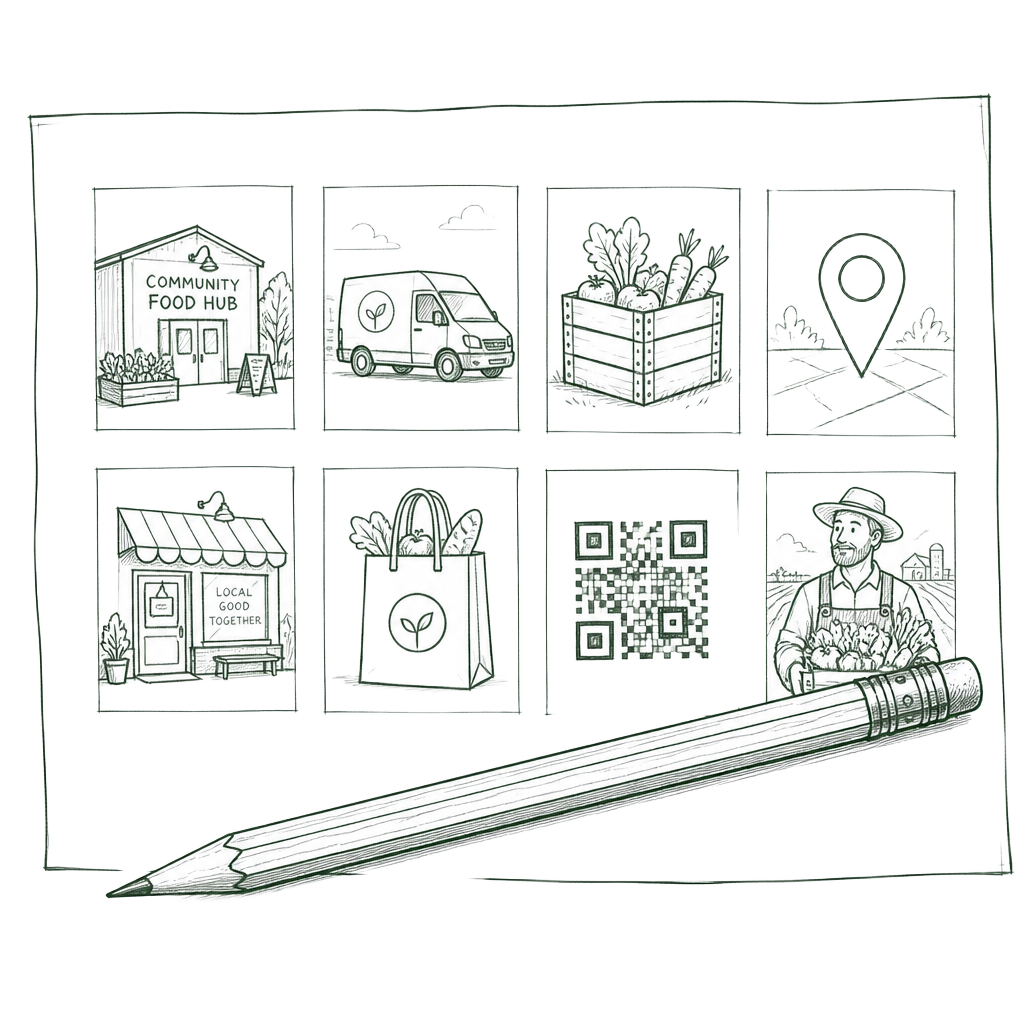
Exploring ecosystem possibilities through Crazy 8's.

After uncovering the deeper system challenges through expert interviews, I intentionally stepped away from high-fidelity design to rapidly explore a wide range of possible solutions.

Using the Crazy 8's exercise, I generated multiple concepts that explored logistics, transparency, automation, and neighborhood infrastructure rather than simply improving the shopping interface.

Several ideas naturally centered around community hubs along the Atlanta BeltLine, revealing a consistent direction for the ecosystem.

Hand-drawn pencil sketch of eight ecosystem concepts explored during the Crazy 8's exercise

Eight rapid concepts. Community Hub emerged as the strongest direction across the sketch set.

View in Figma
01

Community hubs emerged repeatedly

Neighborhood pickup locations consistently appeared across multiple concepts.

02

Infrastructure mattered more than interface

The sketches explored physical systems that protected freshness rather than only improving app screens.

03

Transparency became visible

Concepts explored freshness verification, sourcing, delivery tracking, and fulfillment visibility.

04

Technology supported community

Automation worked best when strengthening local relationships instead of replacing people.

Pattern That Emerged

Across multiple sketches, one pattern consistently emerged: community pickup hubs created the strongest opportunity to connect farmers, fulfillment, logistics, and neighborhoods into one trusted ecosystem.

Four-Step Solution Sketch

From ideation to a testable experience.

The strongest ideas from the Crazy 8's exercise were refined into a four-step experience showing how shoppers discover local vendors, choose delivery or neighborhood pickup, monitor freshness throughout fulfillment, and understand the impact of supporting local food systems. This storyboard became the blueprint for the first prototype.
View in Figma

Chosen concept. Early workflow demonstrating marketplace discovery, multi-vendor checkout, fulfillment tracking, and delivery confirmation.

01

Marketplace Discovery

Help users browse trusted local vendors in one unified marketplace.

02

Unified Checkout

Combine products from multiple producers into a single order with flexible fulfillment options.

03

Transparent Tracking

Provide freshness verification, temperature monitoring, and real-time logistics visibility.

04

Community Impact

Reinforce local impact through verified sourcing, sustainability metrics, and neighborhood fulfillment.

The Sketch Phase

The sketching phase transformed research insights into a tangible ecosystem concept, providing the foundation for Fresh Flow's high-fidelity designs and prototype.

Chosen Concept

A Transparent Local Food Ecosystem

After synthesizing interviews, affinity mapping, and concept exploration, I selected a service ecosystem that connects local producers, neighborhood pickup hubs, and autonomous delivery. Rather than solving only the grocery shopping experience, Fresh Flow addresses the entire fulfillment journey—from producers to customers—creating a more transparent and community-centered food network.

Community First

Designed around local producers and neighborhood access.

Transparent Fulfillment

Customers can see sourcing, freshness, and delivery every step of the journey.

Connected Infrastructure

Farmers, fulfillment hubs, autonomous delivery, and neighborhood pickup locations operate as one coordinated ecosystem.

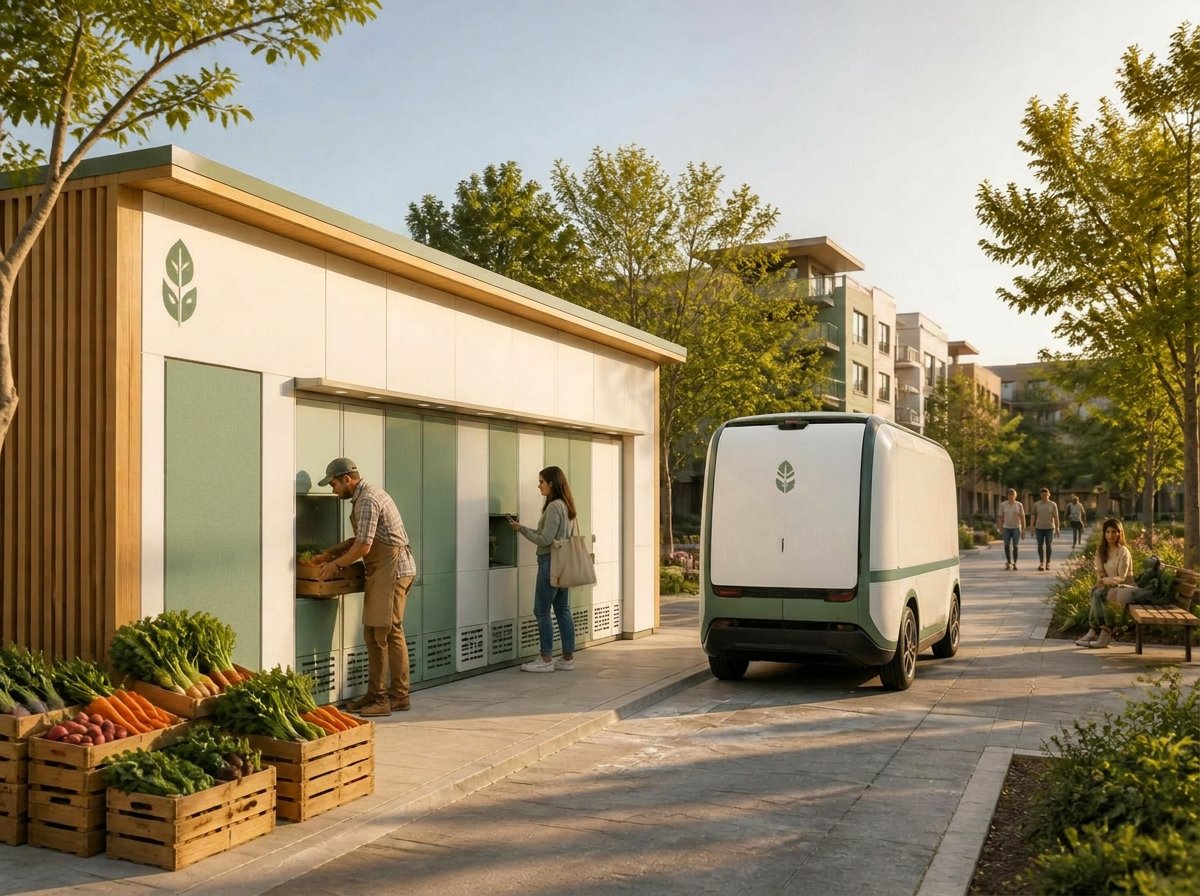
Architectural concept rendering of a Fresh Flow neighborhood pickup hub: Scandinavian-inspired refrigerated locker structure with a farmer restocking produce, a customer retrieving groceries via mobile phone, an autonomous electric delivery van, and neighbors walking through the landscaped public space.
Neighborhood Pickup Hub Concept

Pilot Environment

Why the Atlanta Beltline?

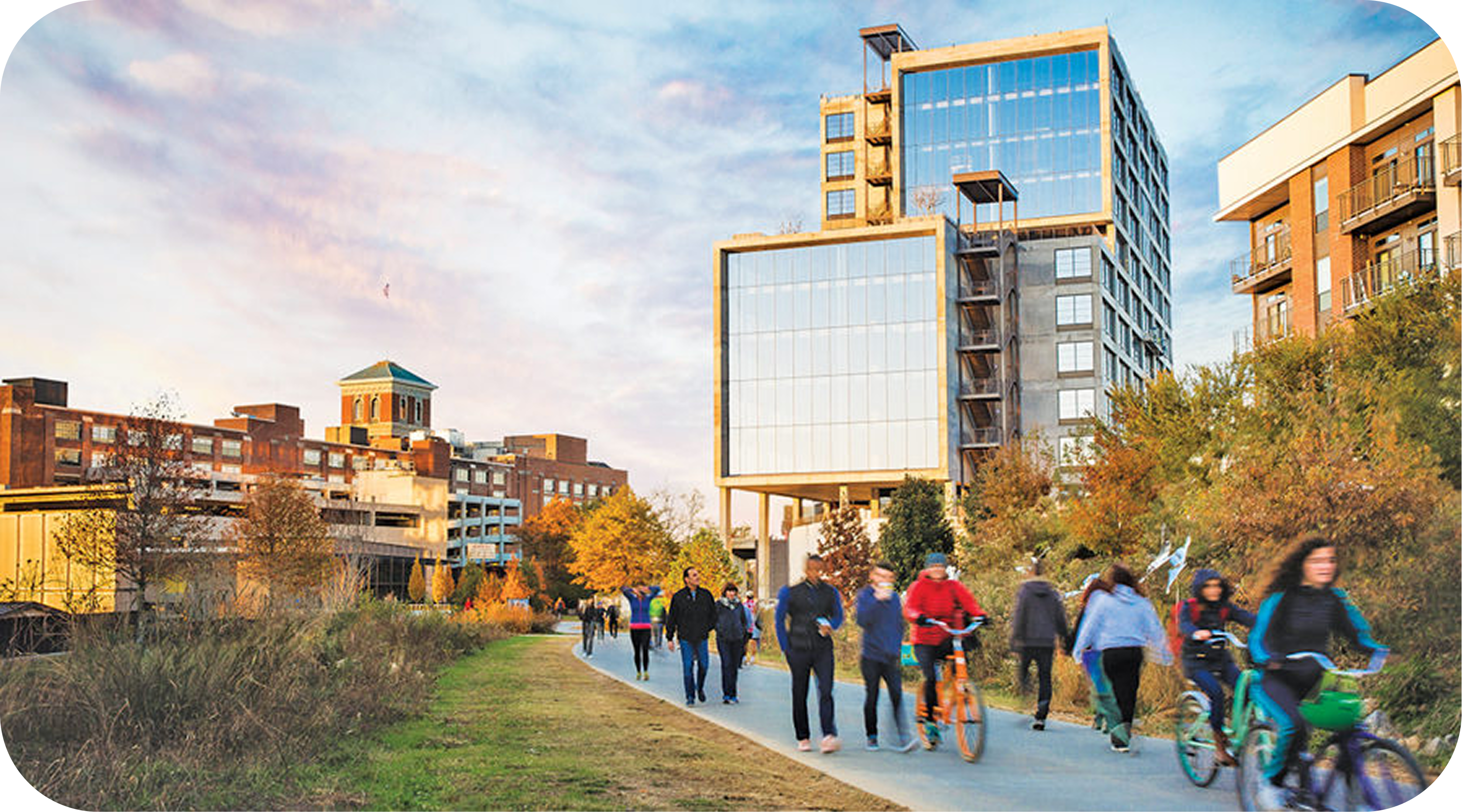
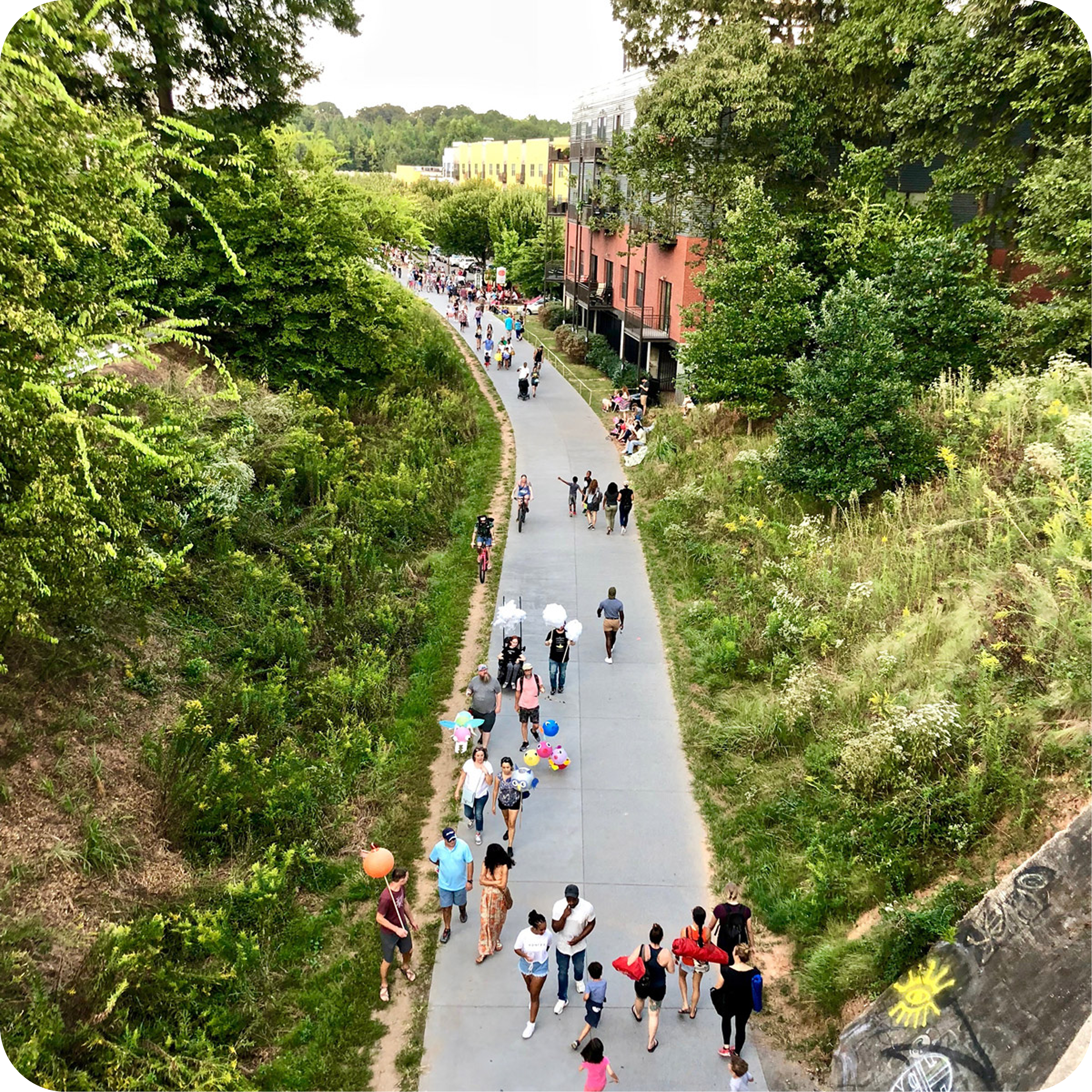
The Atlanta BeltLine is a major urban redevelopment project that transforms former railroad corridors into a loop of trails, parks, public art, and future transit around Atlanta. Its purpose is to connect neighborhoods, improve walkability and biking, expand green space, support local economic growth, and promote community equity and affordable housing.

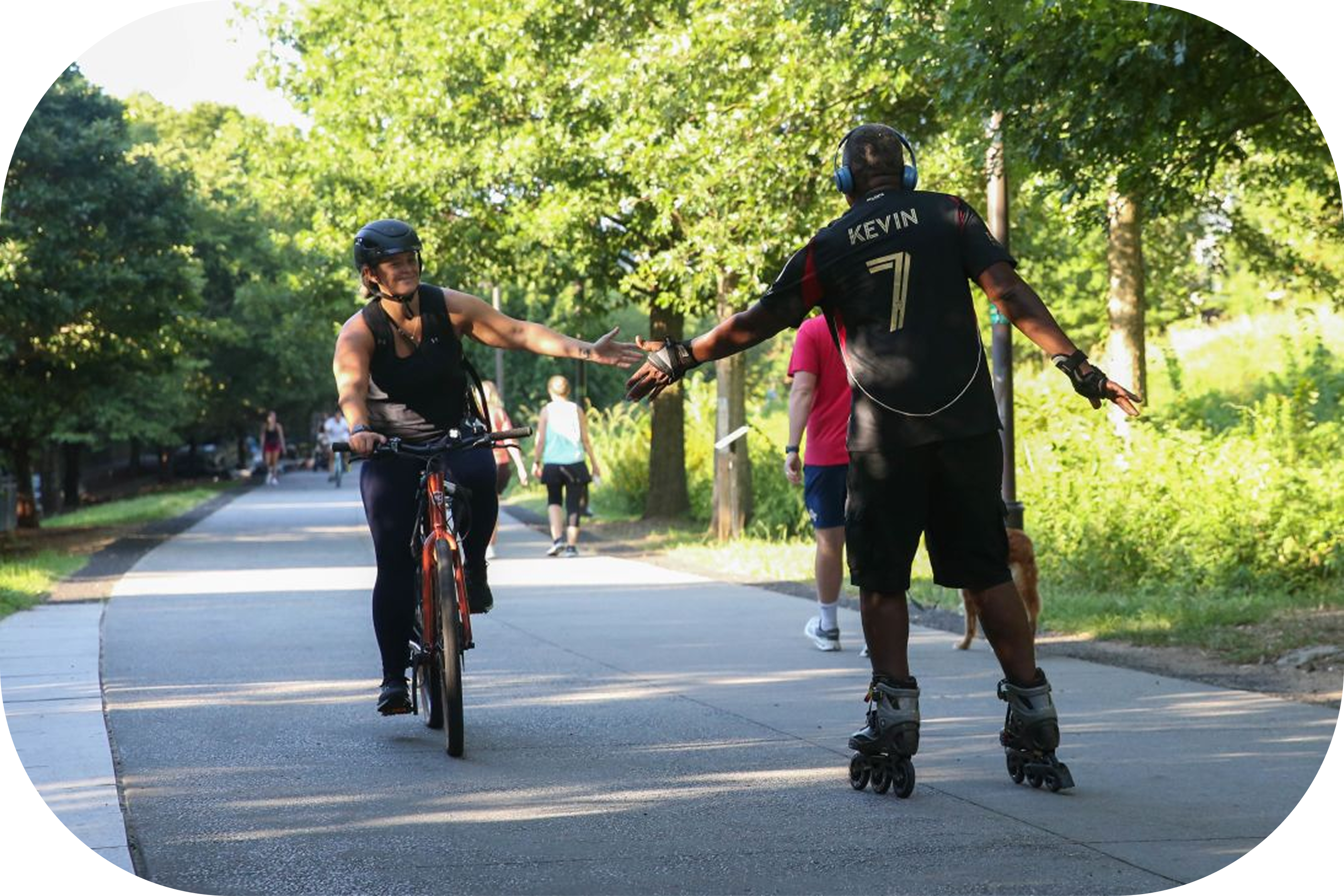
Even though my interviewees don't live directly on the BeltLine, their ATL lifestyles match the people who use it every day. With its foot traffic, food culture, and neighborhood energy, the BeltLine became the perfect testing ground for Fresh Flow.

Starting on the Beltline lets Fresh Flow test small learn fast and eventually scall across Atlanta.

Why It Fits

A High-Energy Movement Hub

Built-In Foot Traffic for Real Testing

Surrounded by Food + Community Spots

A Natural Fit for Fresh Flow's Mission

Scalable, Safe, and Fundable

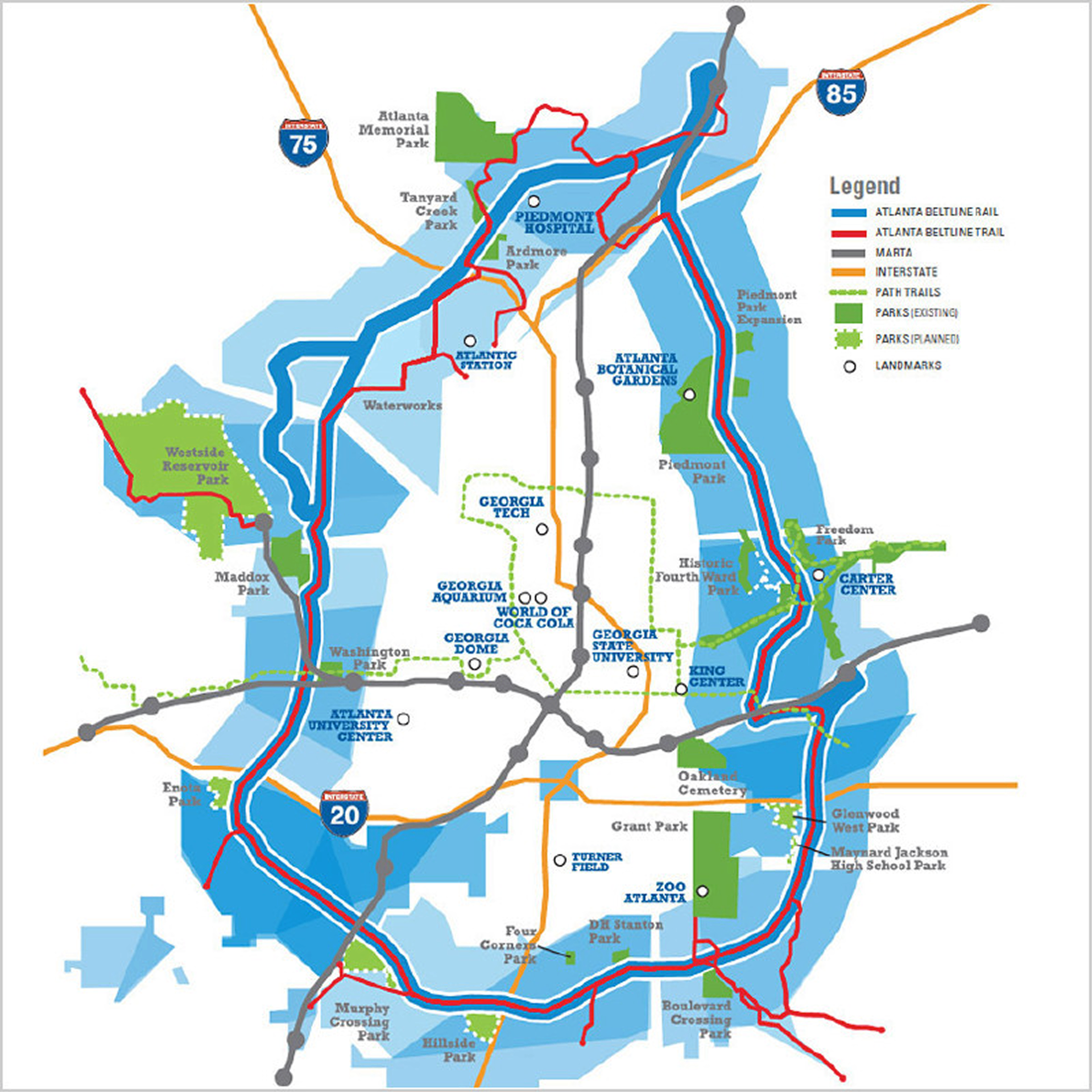
Map of the Atlanta BeltLine

Illustrated map of Atlanta showing the BeltLine loop and pilot hub locations

Pilot Corridor

The Atlanta BeltLine

Atlanta BeltLine logo
BeltLine opening event
Aerial view of the BeltLine Eastside Trail
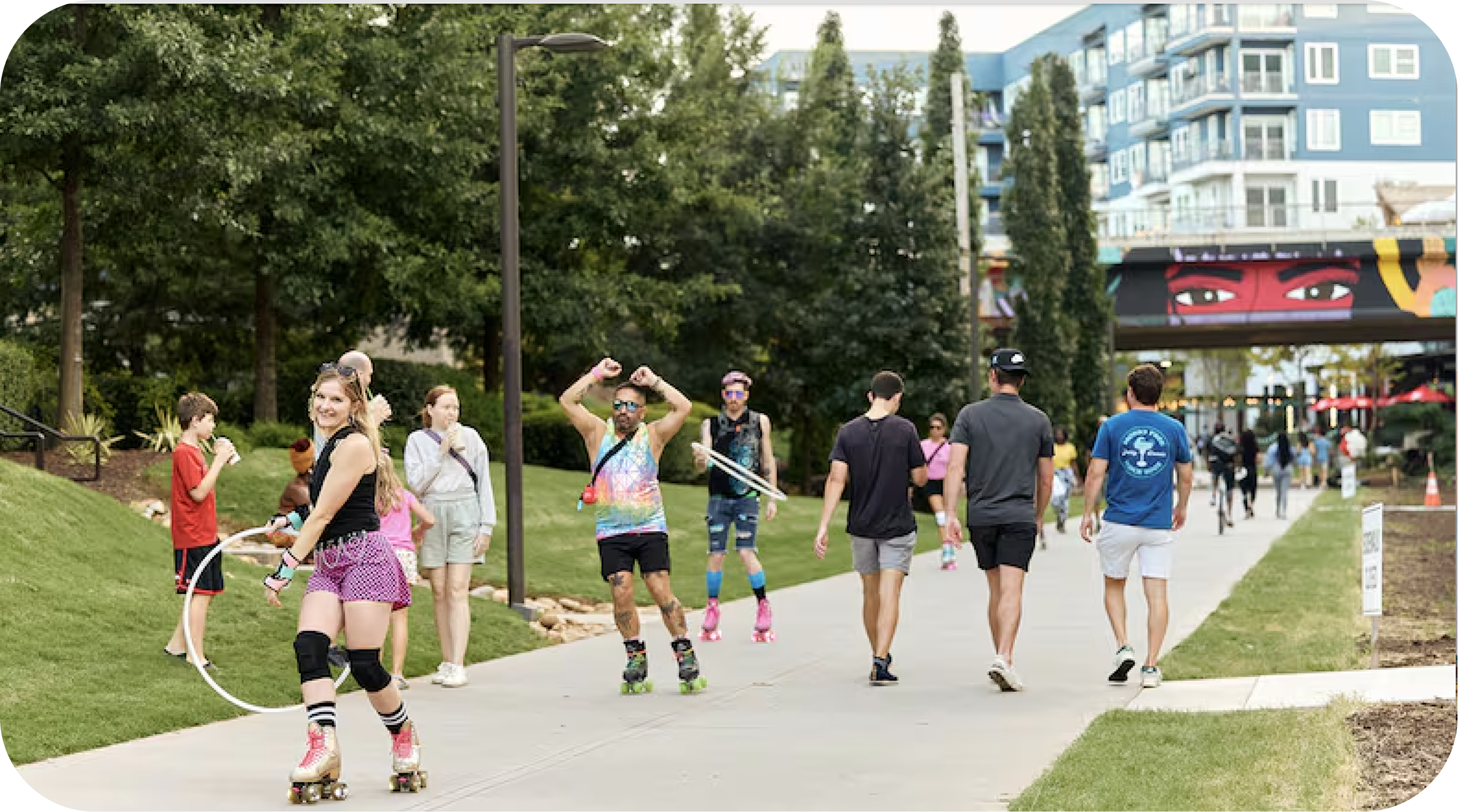
Community life along the BeltLine
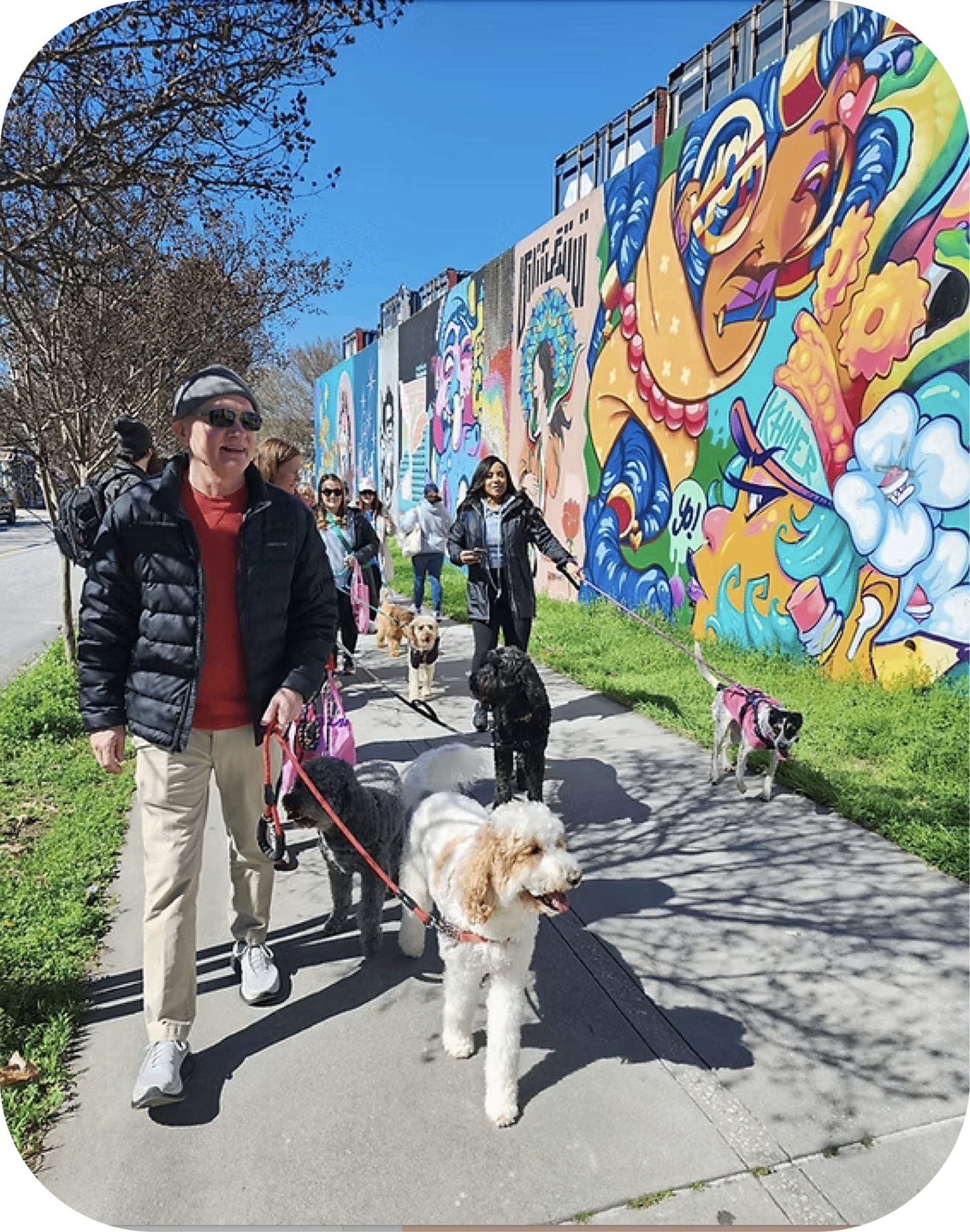
Group walking dogs along a BeltLine mural
Skateboarder at the BeltLine skate park
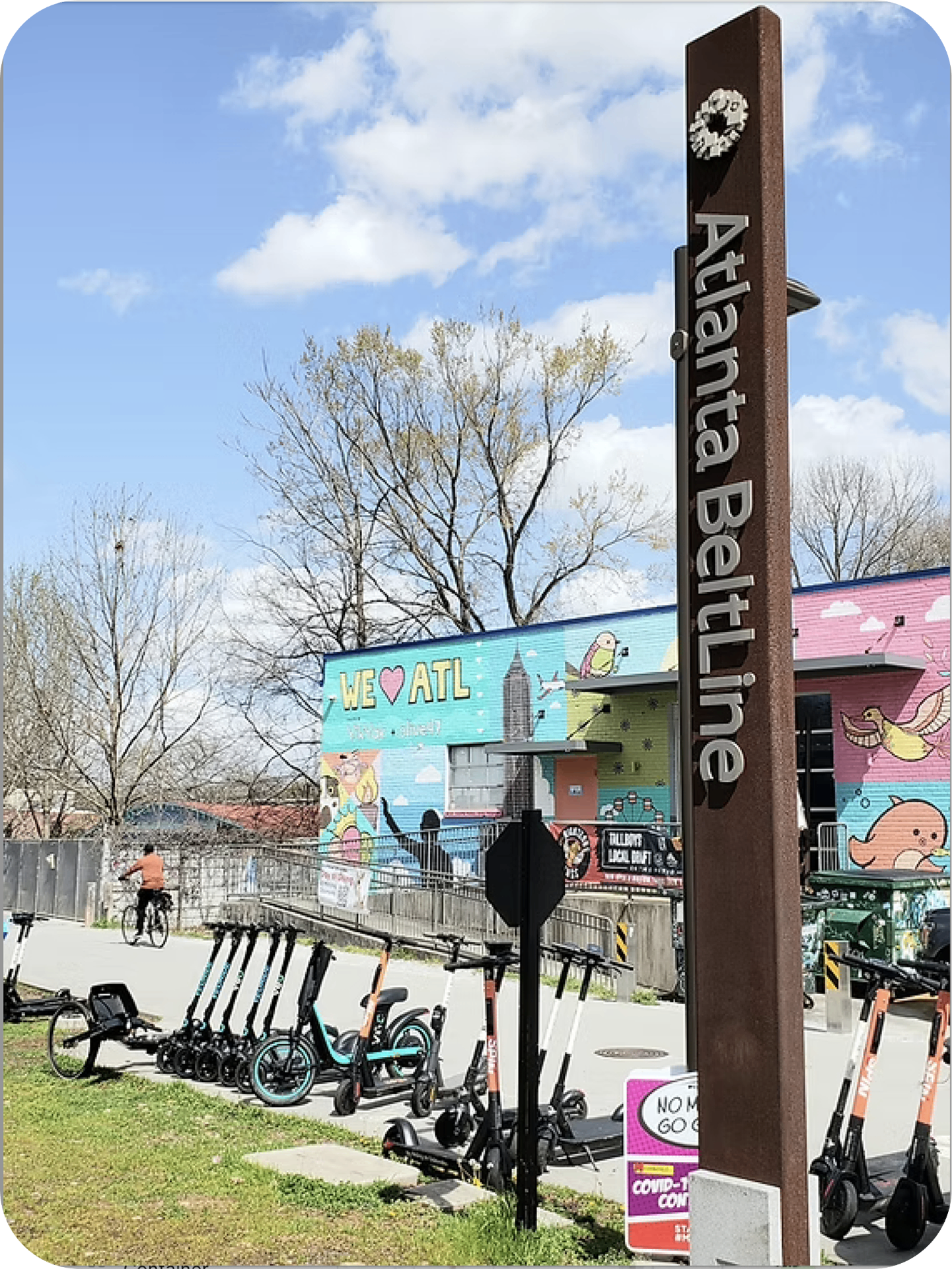
Atlanta BeltLine trail marker with scooters and murals
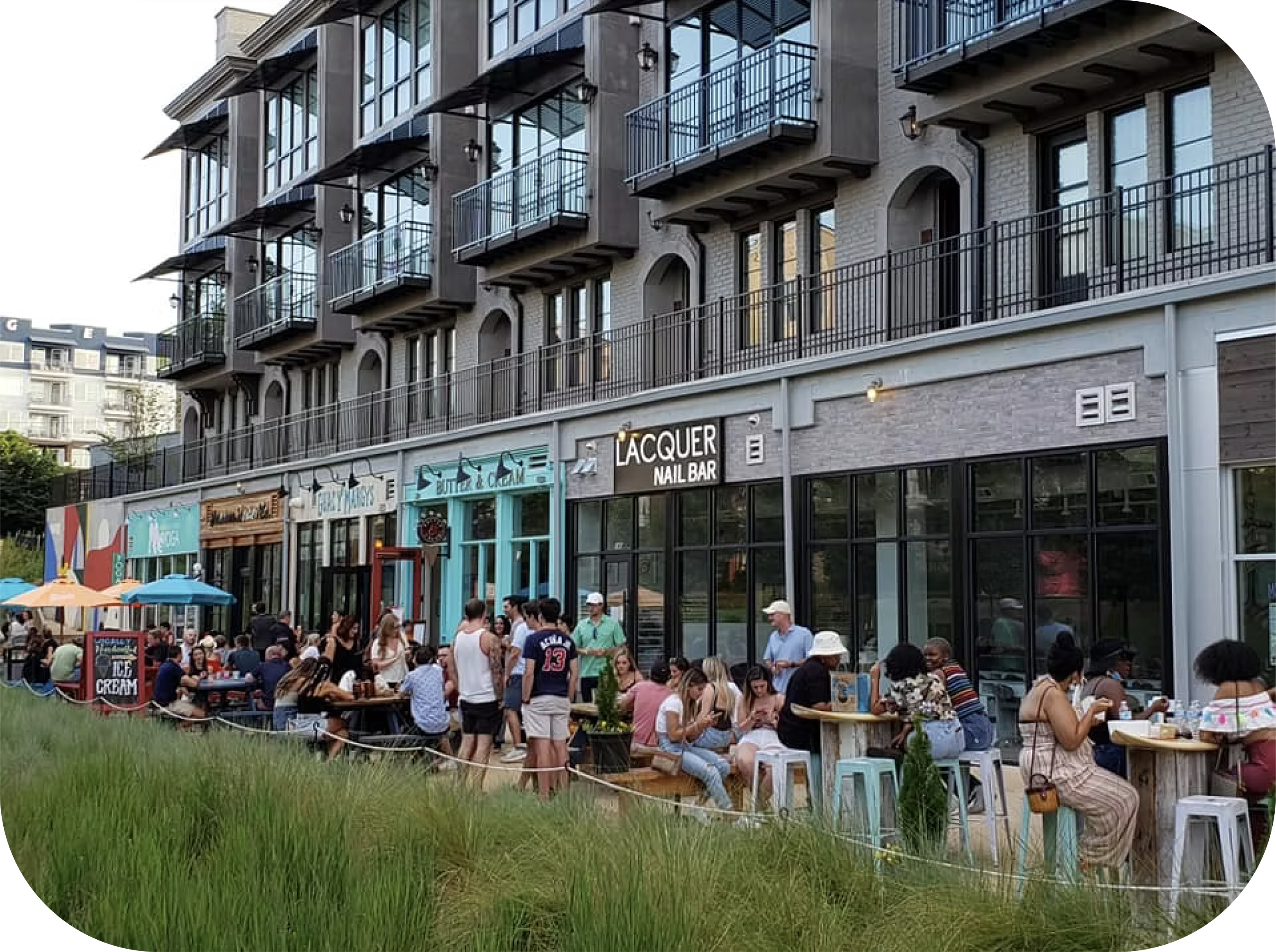
BeltLine neighborhood scene

Community · Movement · Local Food

05 · Brand Identity

Brand Identity

Fresh Flow's identity was inspired by the Atlanta BeltLine and Georgia's local food ecosystem. Every design decision reinforces community, trust, movement, and sustainability while creating a consistent experience across the app, kiosks, dashboards, and delivery touchpoints.

Fresh Flow logo — Atlanta BeltLine drawn as a continuous loop with a green leaf

A mark shaped like the city it feeds.

Logo Inspiration

Inspired by the Atlanta BeltLine, symbolizing connection, movement, and local food.

Color Palette

Natural greens and warm earth tones represent freshness, trust, and sustainability.

Green
Peach
Earth
Cream

Typography

A clean, modern type system designed for readability across every touchpoint.

Fresh Flow

Display + body type built for clarity.

Design Principles

  • Community
  • Transparency
  • Simplicity
  • Sustainability

Every visual element was designed to build trust and create a consistent experience across the entire Fresh Flow ecosystem.

Pilot Rollout Strategy

Launch Small. Learn Fast. Scale Confidently.

Fresh Flow begins with a focused pilot along the Atlanta BeltLine to validate customer demand, vendor participation, and logistics before expanding across Atlanta.
01

Pilot Corridor

One high-traffic BeltLine neighborhood.

02

Launch 3 Pickup Hubs

Test convenient neighborhood pickup.

03

Measure Performance

Track adoption, vendors, and delivery.

04

Optimize Operations

Refine inventory, routing, fulfillment.

05

Expand Across Atlanta

Scale only after the pilot is validated.

Pilot Principle

Test Learn Improve Scale

Every expansion is guided by customer feedback, operational performance, and usability testing.

Interactive Pilot Hub Explorer

Explore why each BeltLine hub was selected.

Click a hub, tap a map pin, or use the Prev / Next controls to see the research, benefits, and delivery route behind each pilot location.

Fresh Flow Pilot: High-Traffic BeltLine Hubs

Three pilot locations along the Atlanta BeltLine. Click a pin on the map to explore why each site was selected.

Fresh FlowAtlanta BeltLine

Interactive prototype embedded from Figma Make. Click pins to explore each pilot hub.

Concept Storyboards

Parallel storyboards for consumers and vendors.

To validate the concept from every perspective, I designed parallel experiences for both consumers and vendors before beginning usability testing.

Early Prototype Exploration

Low-fidelity prototypes.

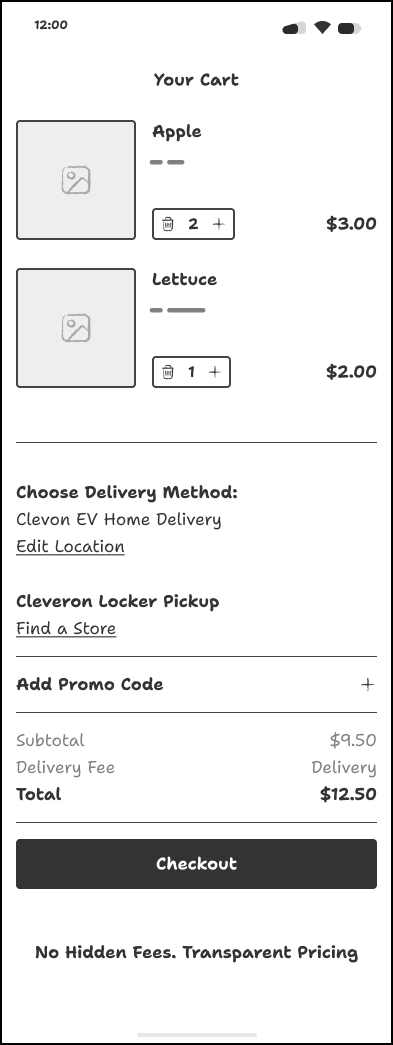
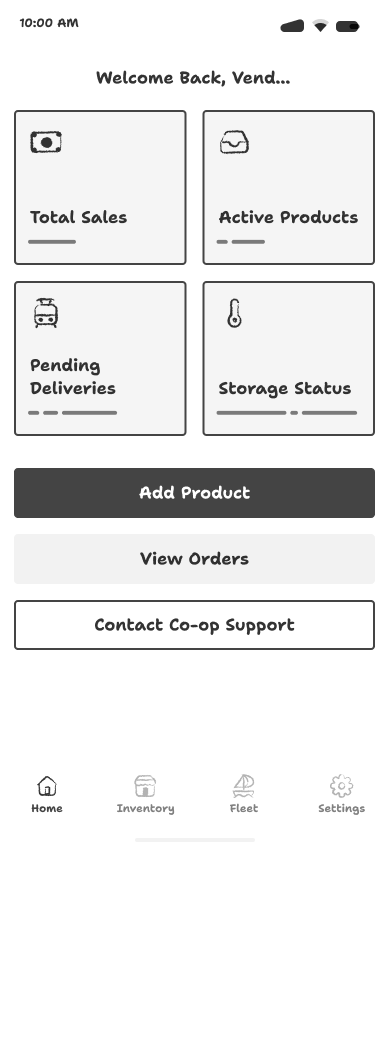
Before designing the final Fresh Flow experience, I created low-fidelity wireframes to define the core user flows and overall platform structure. These early concepts focused on navigation, information architecture, and task flow before visual design.

Consumer Low-Fidelity Prototype

Explored the shopper journey from product discovery through checkout, focusing on navigation, screen hierarchy, and task flow.

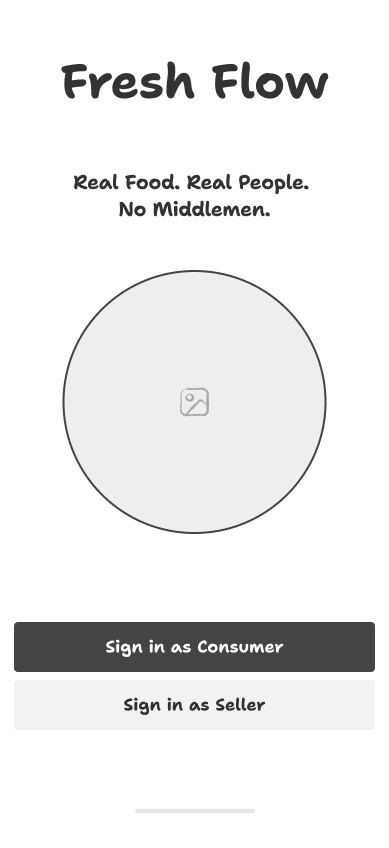
Fresh Flow consumer sign-in screen
Browse local organic foods
Cart and delivery method
Track delivery
Cleveron locker pickup
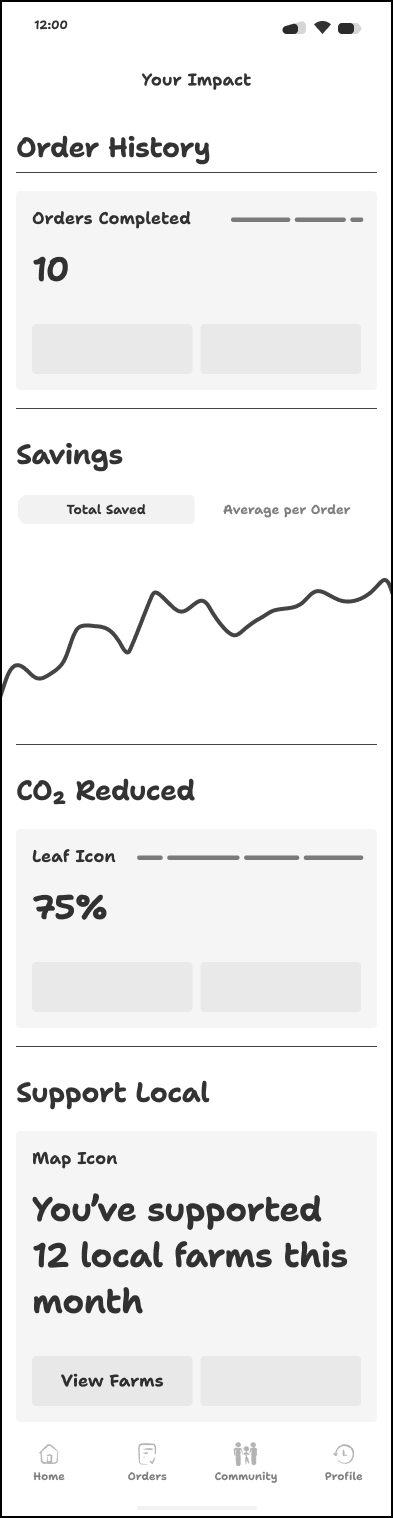
Your impact dashboard
1 / 6

Vendor Dashboard Low-Fidelity Prototype

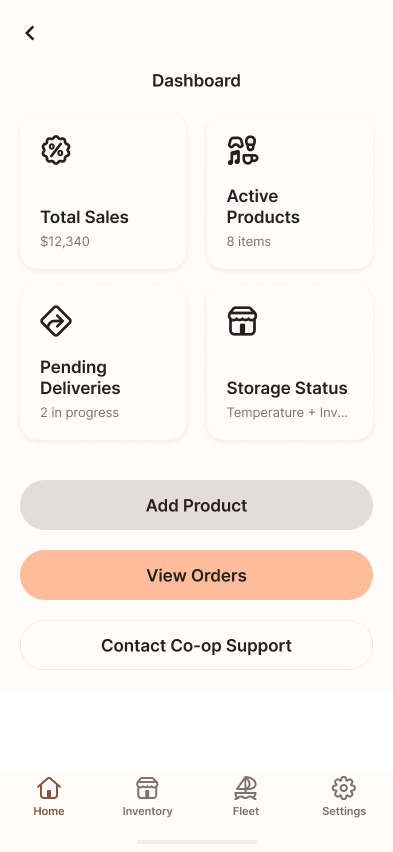
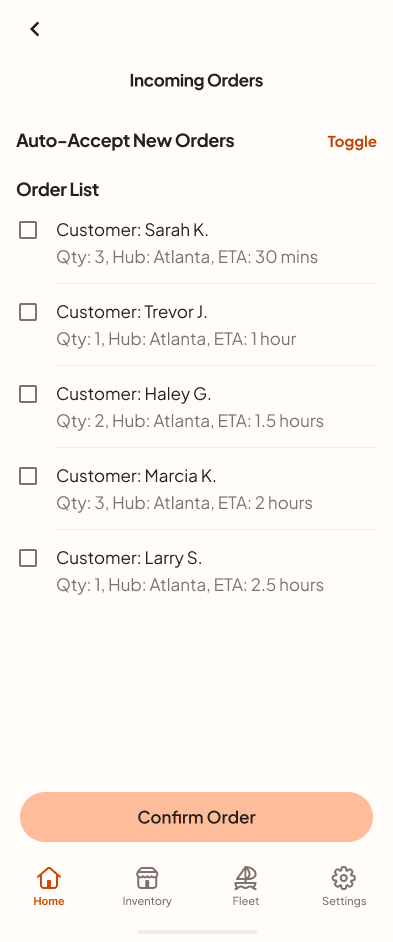
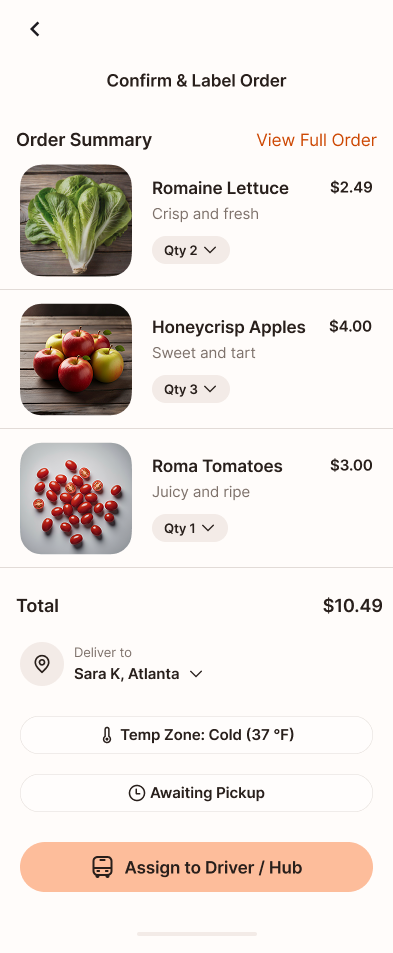
Defined the vendor workflow for inventory, fulfillment, and storage management, establishing the operational structure before interface design.

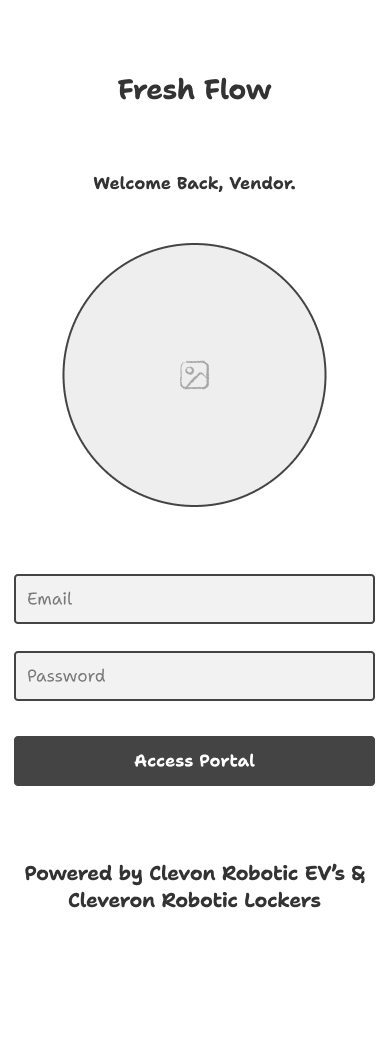
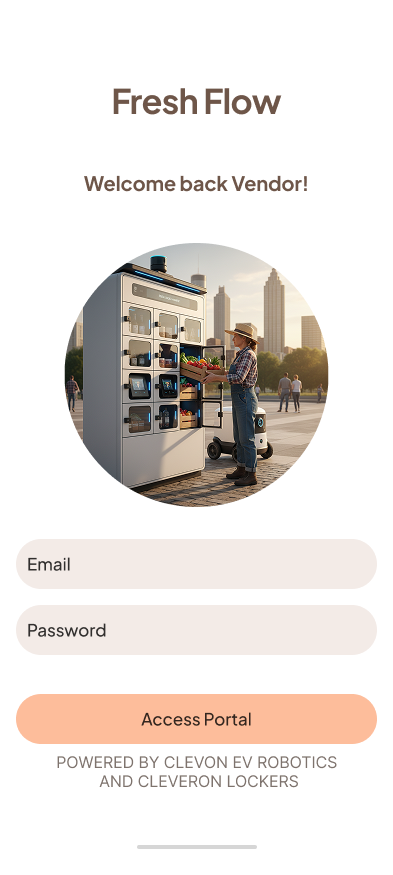
Fresh Flow vendor sign-in
Vendor dashboard overview
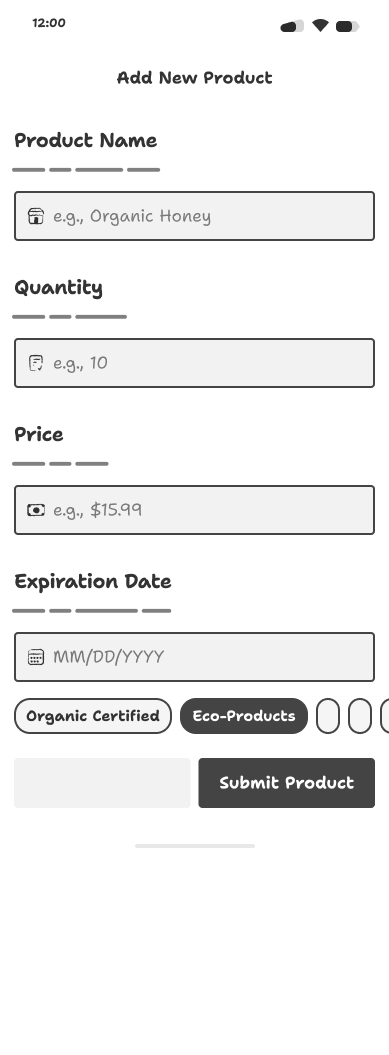
Add new product
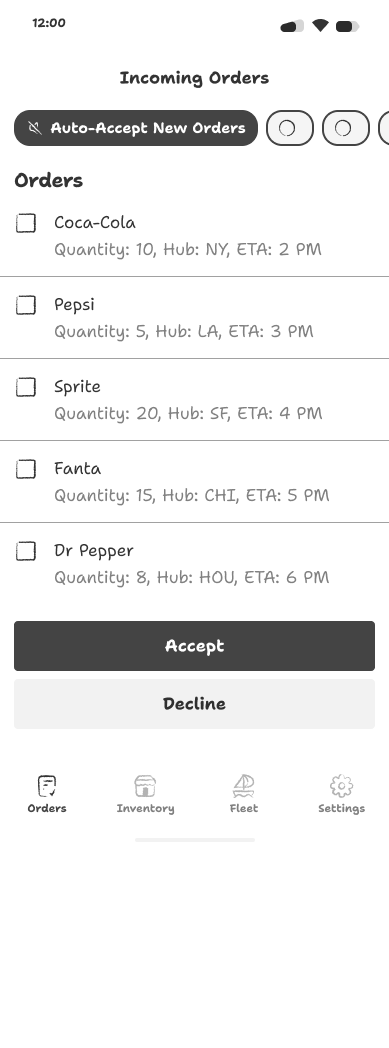
Incoming orders
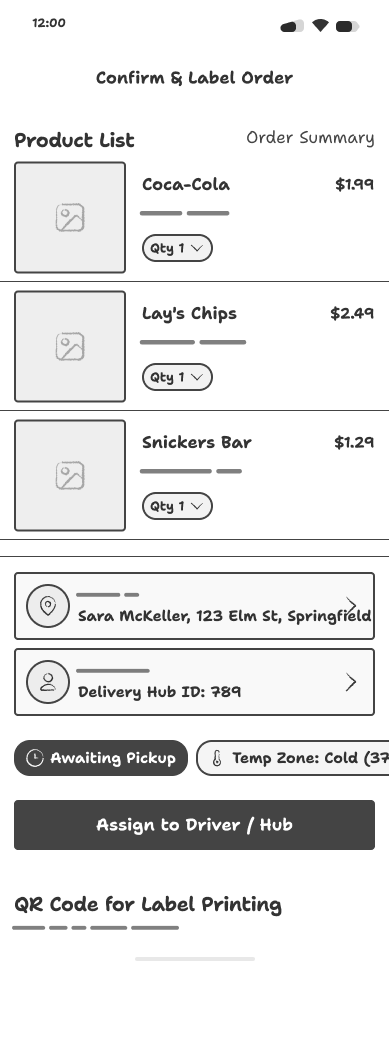
Confirm and label order
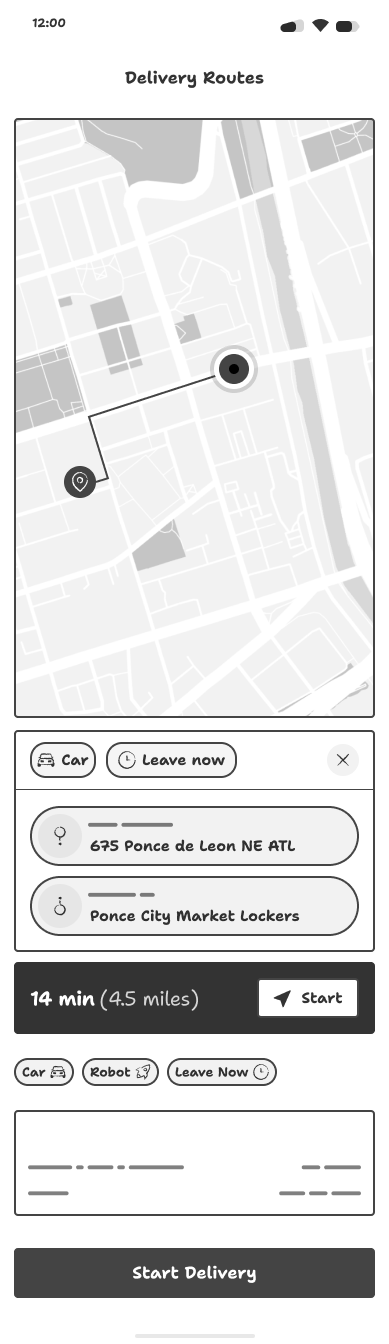
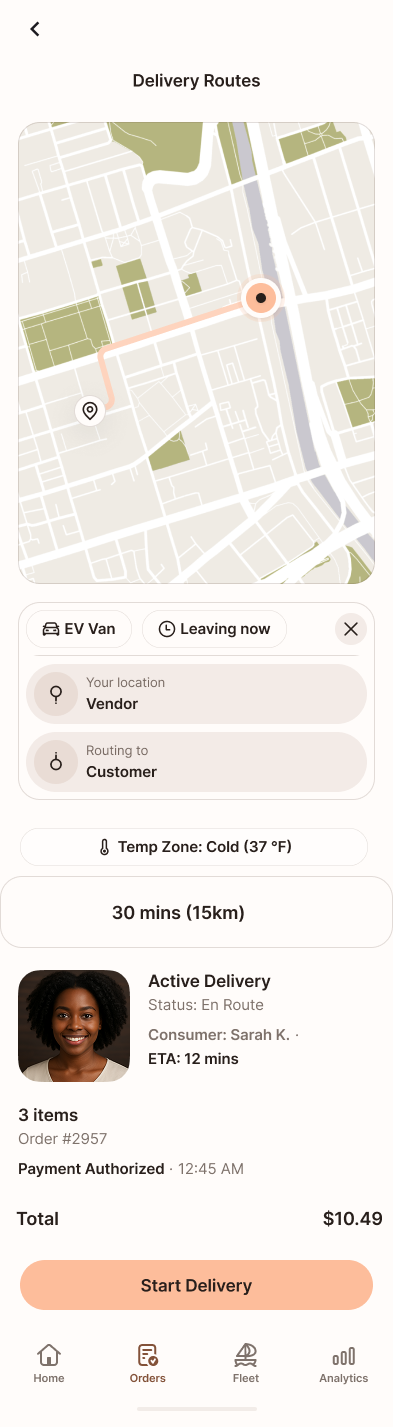
Delivery routes
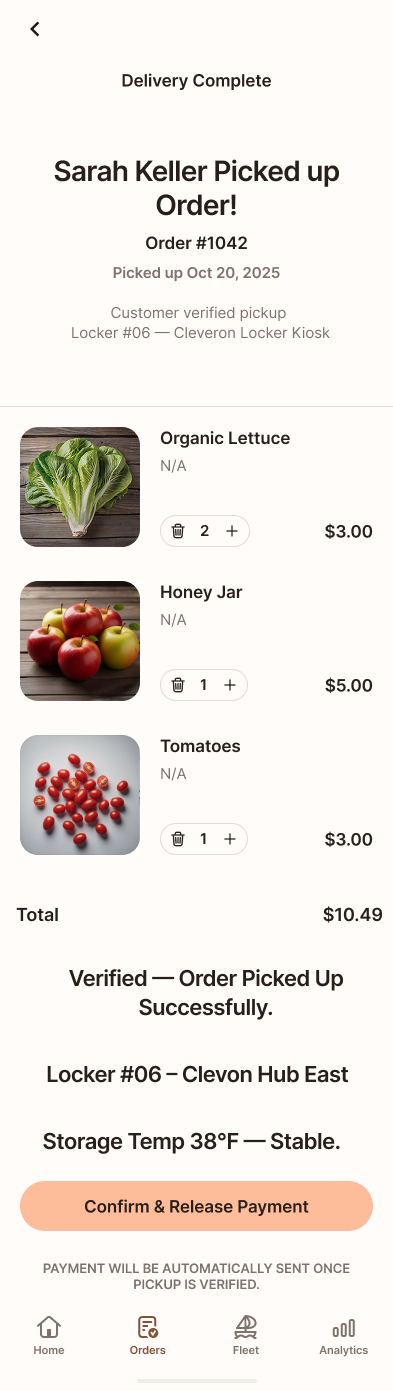
Order delivery complete
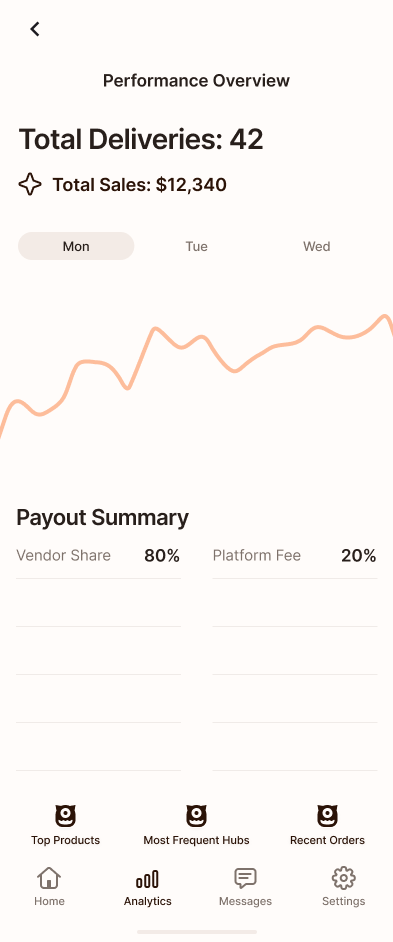
Performance overview analytics
1 / 8

Refined Prototype Iteration

Medium-fidelity prototypes.

Using the low-fidelity wireframes as a foundation, I refined the core user journeys into more realistic prototypes that were used during Round 1 usability testing.

Consumer Medium-Fidelity Prototype

Refined the shopping experience with product discovery, checkout, delivery tracking, and pickup workflows.

Fresh Flow consumer sign-in — medium fidelity
Browse local organic foods — medium fidelity
Your cart and checkout — medium fidelity
Track delivery — medium fidelity
Cleveron locker pickup — medium fidelity
Your impact dashboard — medium fidelity
1 / 6

Vendor Dashboard Medium-Fidelity Prototype

Expanded the vendor workflow with inventory, fulfillment, delivery coordination, and operational management.

Fresh Flow vendor sign-in — medium fidelity
Vendor dashboard — medium fidelity
Incoming orders — medium fidelity
Confirm and label order — medium fidelity
Delivery routes — medium fidelity
Delivery complete — medium fidelity
Performance overview — medium fidelity
1 / 7

User Research

Round 1 Usability Testing

Medium-fidelity prototypes were tested with stakeholders across farming, logistics, finance, and technology to evaluate operational workflows, trust, and usability. The findings revealed that Fresh Flow's greatest opportunity was strengthening its logistics foundation before expanding the customer experience.
Who We Spoke With

Interview Participants

Keallah Smith, Farmer + Agricultural Operations
Keallah Smith
Farmer + Agricultural Operations
Jason Hicks, Logistics, Finance & Investment
Jason Hicks
Logistics, Finance & Investment
Tate Tewksberry, Farmer + Agricultural Operations
Tate Tewksberry
Farmer + Agricultural Operations
Sean Joseph, Senior Software Engineer
Sean Joseph
Senior Software Engineer

Testing Goals

What participants tested.

Participants completed realistic logistics tasks including:

  • Reviewing freshness verification
  • Managing vendor workflows
  • Tracking deliveries
  • Evaluating payout transparency
  • Assessing operational clarity
Research Insights

Research Summary

Key insights from Round 1 usability testing.

Logistics Before Features

Operational reliability mattered more than expanding customer-facing features.

Trust Through Transparency

Participants wanted visible freshness verification and shipment transparency.

Simplified Vendor Workflows

Vendors needed fewer steps and better visibility across fulfillment.

Farmer Protection

Reliable payouts and reduced operational risk were essential for adoption.

Design Shift

From customer interface to logistics ecosystem.

Round 1 changed the direction of Fresh Flow. Rather than continuing to refine the marketplace experience, research showed the platform first needed a reliable logistics ecosystem with transparent verification, operational visibility, and protected farmer payouts. This insight became the foundation for Round 2.

How Might We

How might we design a trusted logistics ecosystem that protects farmers, simplifies operations, and builds trust before scaling the customer experience?

Leading into Round 2

Round 2 — Prototype Evolution

From insights to iteration.

Guided by Round 1 findings, the prototype evolved into a more transparent, operationally focused experience. The redesign prioritized clearer workflows, vendor visibility, and a stronger logistics foundation.

Key Design Changes

Freshness Verification

Added freshness verification and product origin visibility.

Streamlined Vendor Workflow

Simplified vendor operations and inventory management.

Live Order Tracking

Introduced real-time shipment visibility across fulfillment.

Protected Payouts

Improved payout visibility and safeguards for producers.

Round 1Original Prototype
Vendor dashboard — medium fidelity
Incoming orders — medium fidelity
Confirm and label order — medium fidelity
Delivery routes — medium fidelity
Delivery complete — medium fidelity
Performance overview — medium fidelity
1 / 6
Round 2Redesigned Prototype
Round 2 redesigned prototype — screen 1
Round 2 redesigned prototype — screen 2
Round 2 redesigned prototype — screen 3
Round 2 redesigned prototype — screen 4
Round 2 redesigned prototype — screen 5
Round 2 redesigned prototype — screen 6
Round 2 redesigned prototype — screen 7
Round 2 redesigned prototype — screen 8
Round 2 redesigned prototype — screen 9
Round 2 redesigned prototype — screen 10
1 / 10

Design Evolution

The redesigned prototype introduced clearer workflows, operational visibility, and a more scalable experience for vendors and farmers.

Final Interactive Prototypes

Three connected prototypes.

These represent the refined, high-fidelity prototypes developed after usability testing and design iteration. Each prototype tested a different part of the Fresh Flow ecosystem while sharing the same operational infrastructure.

Consumer Prototype

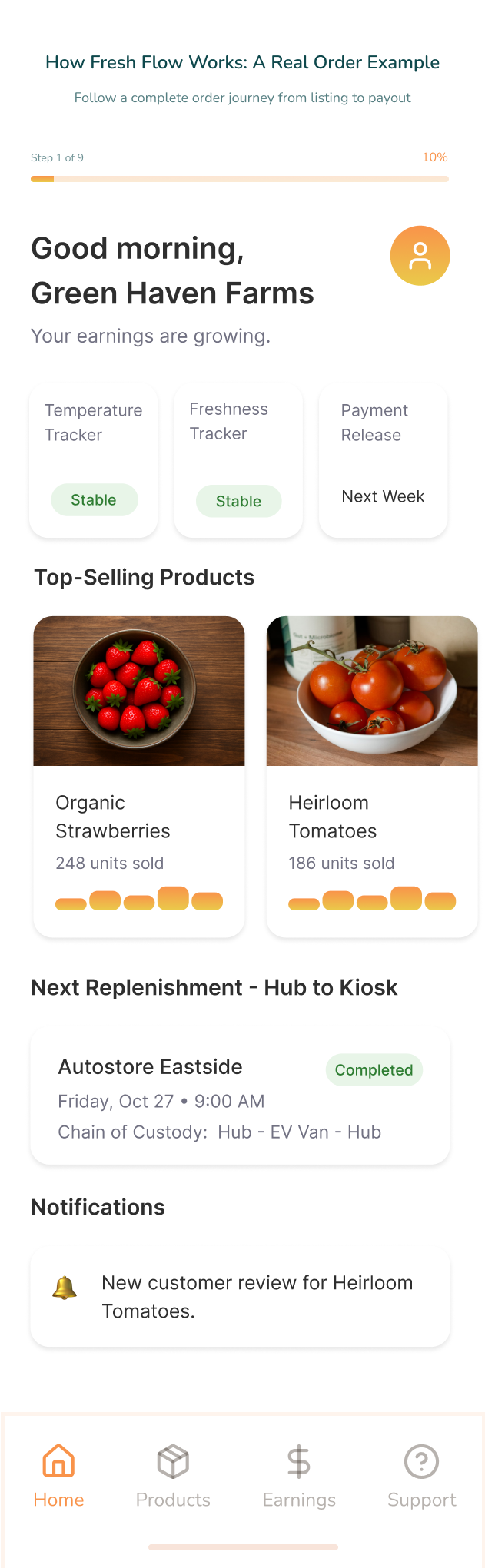
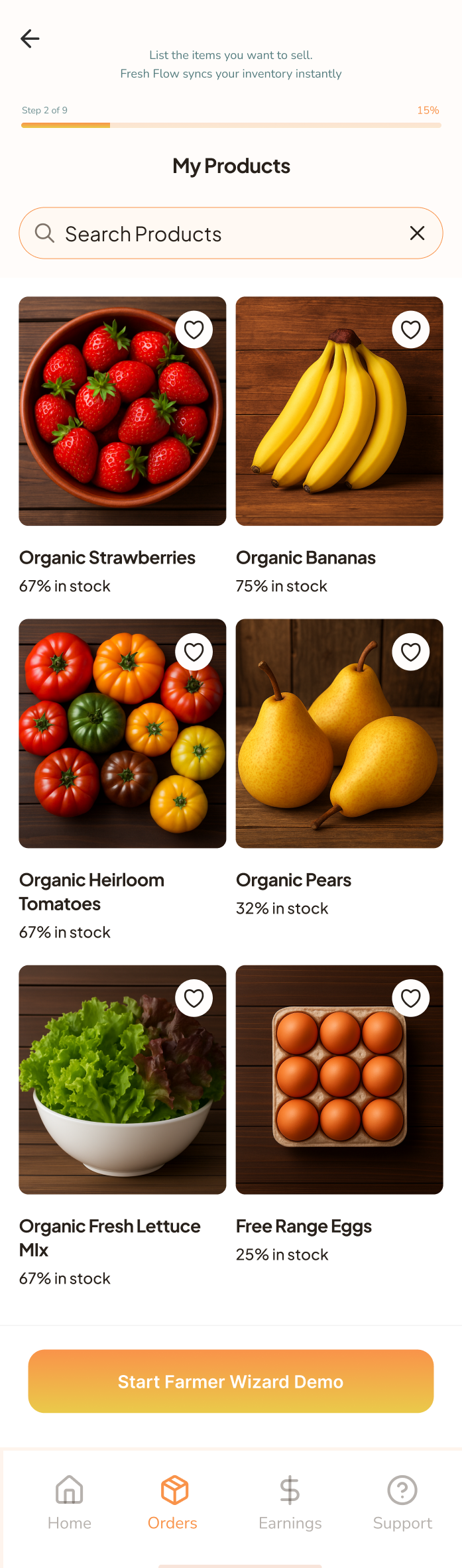
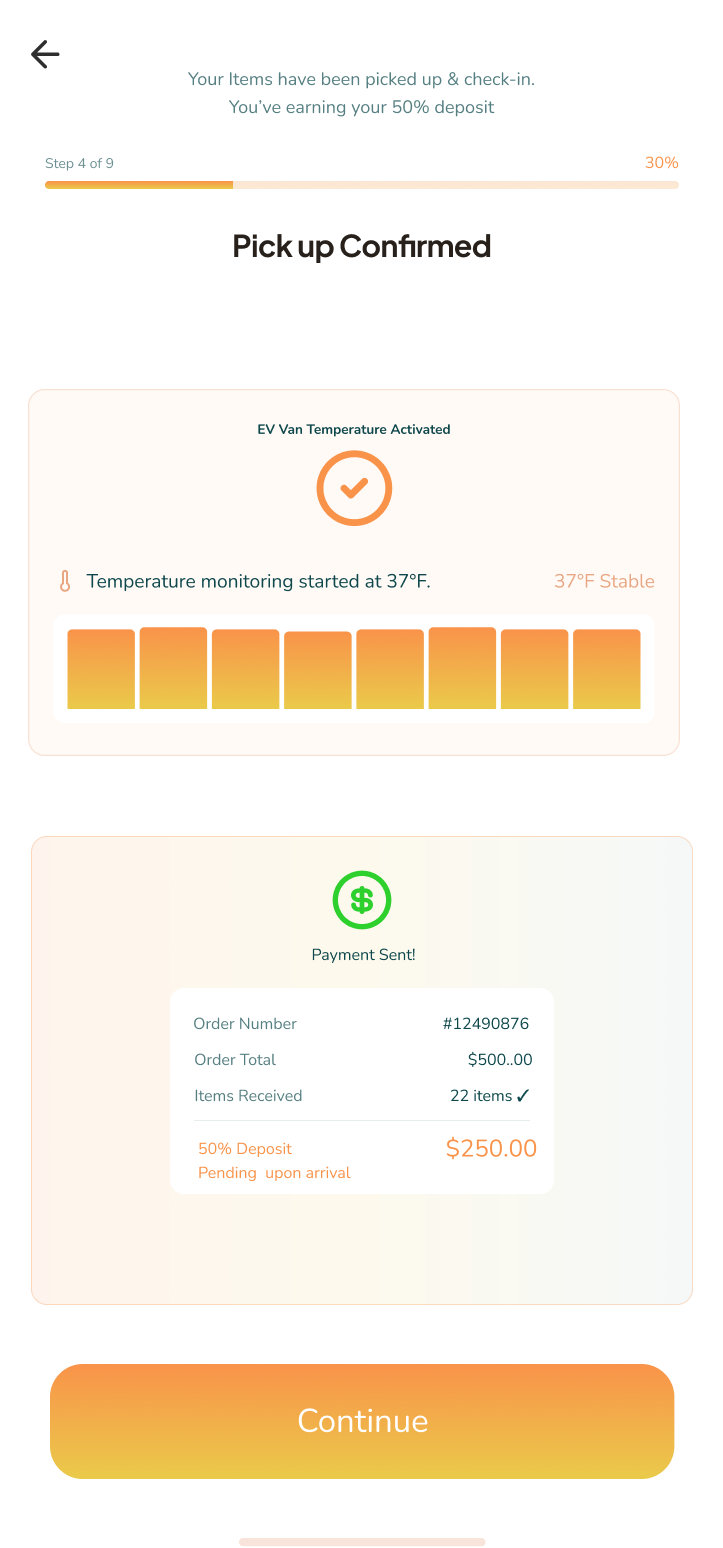
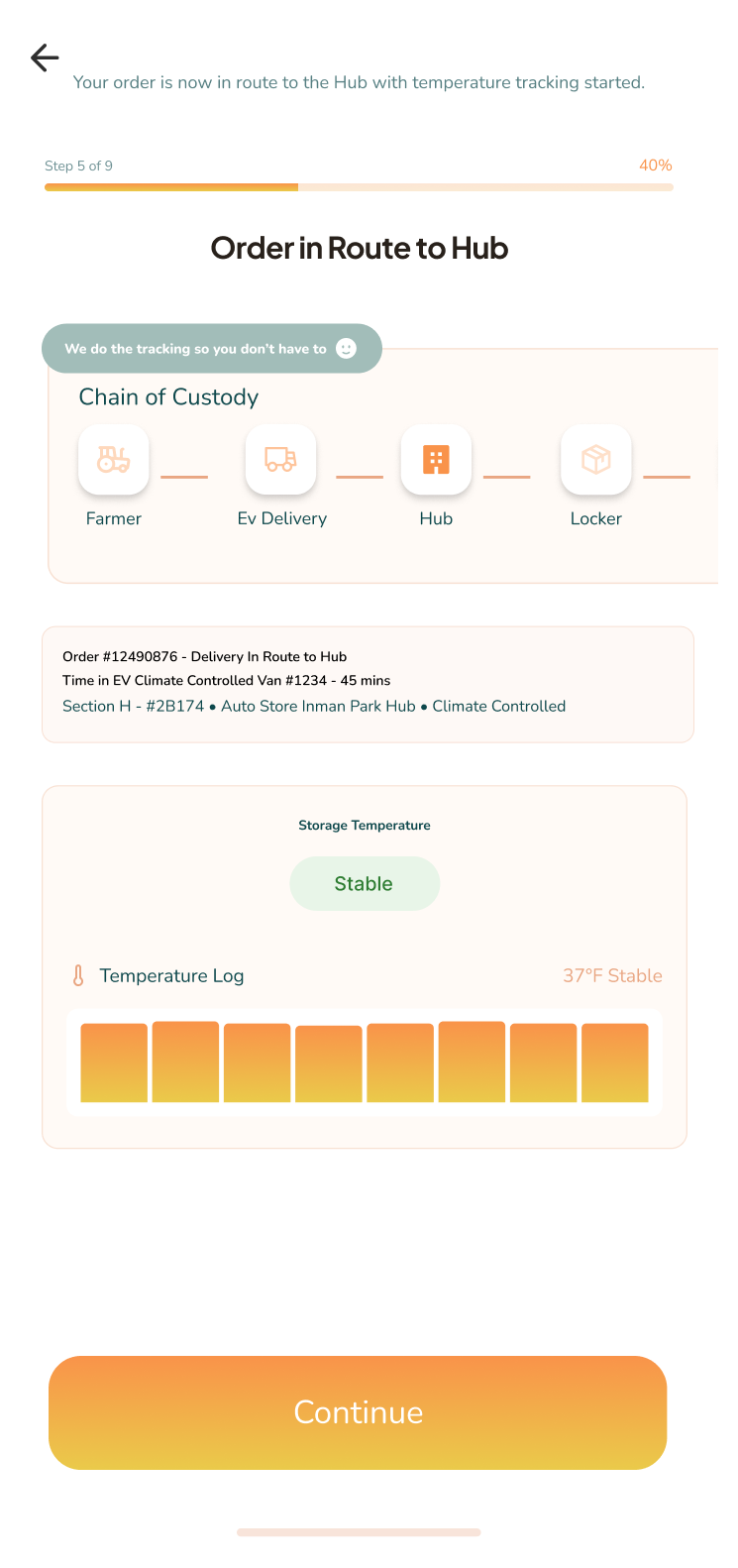
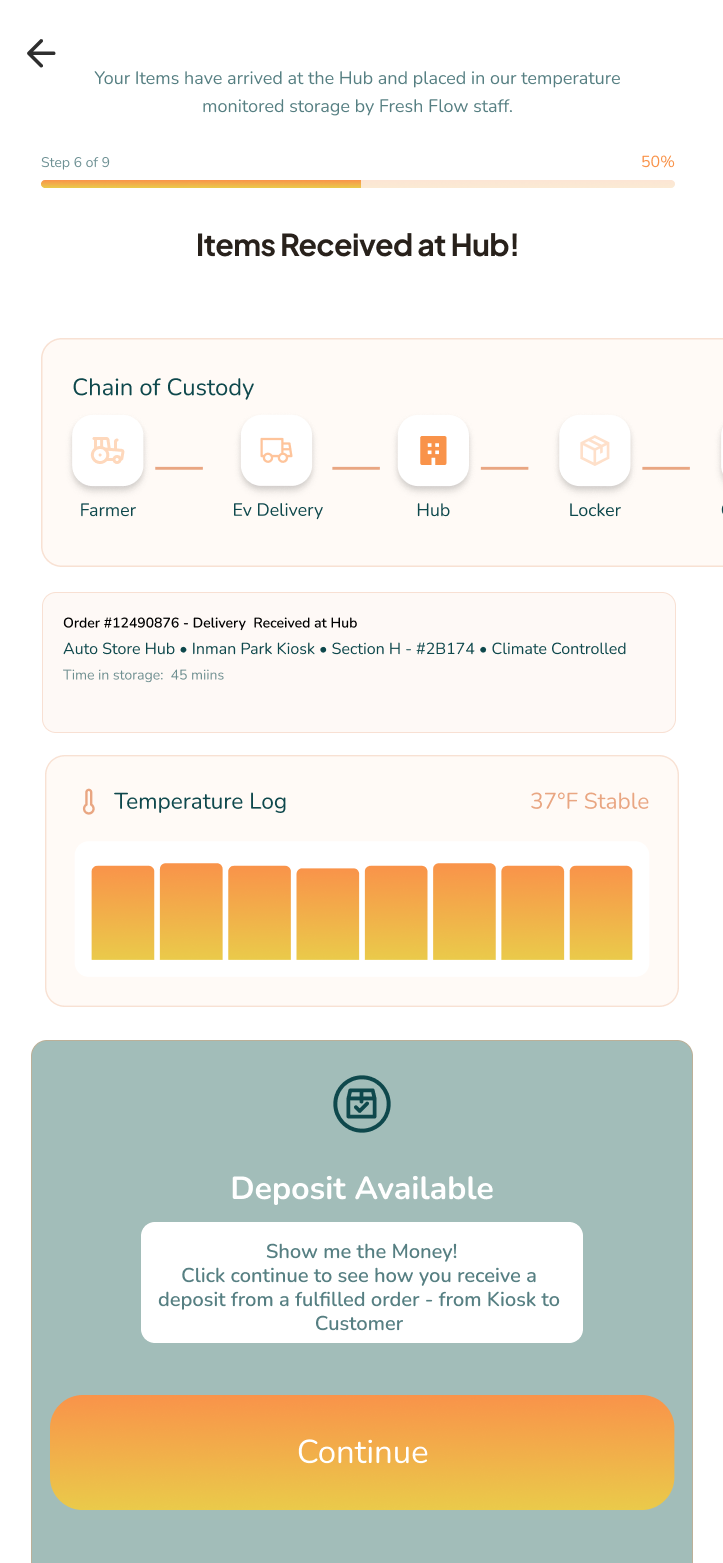
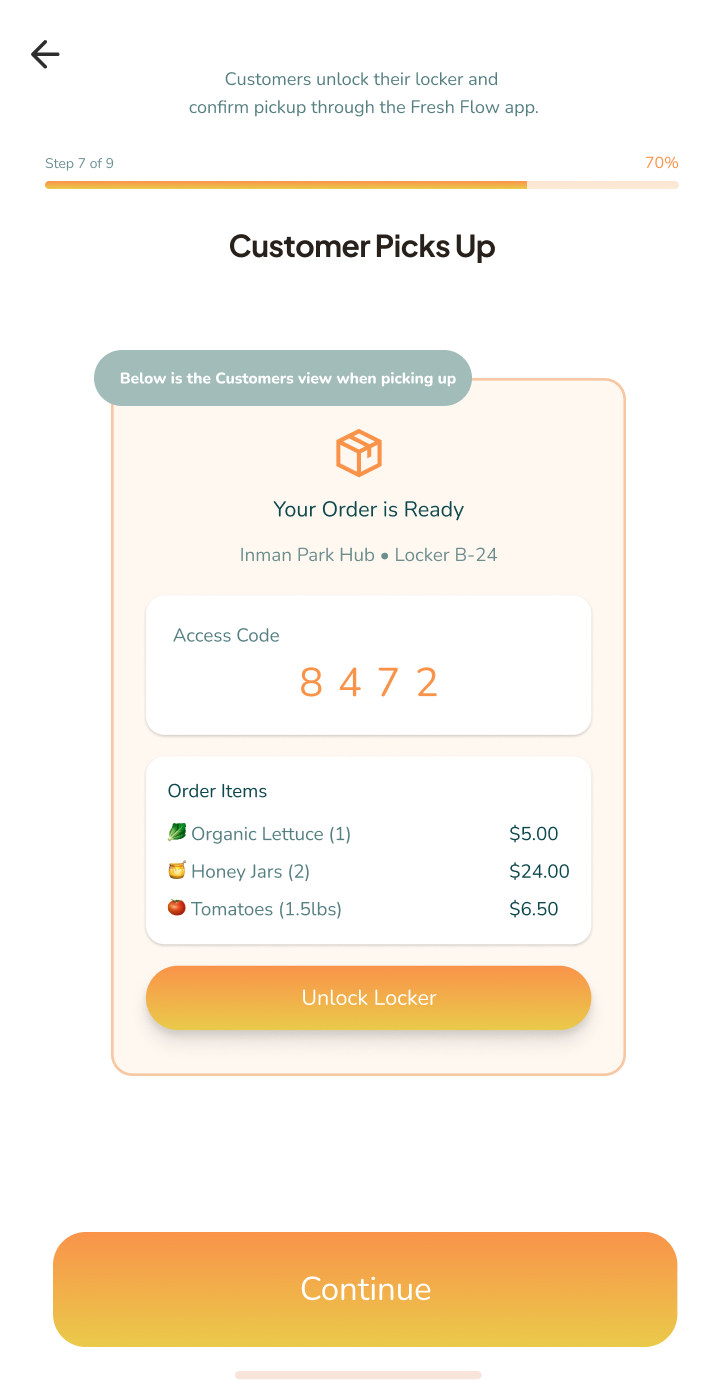
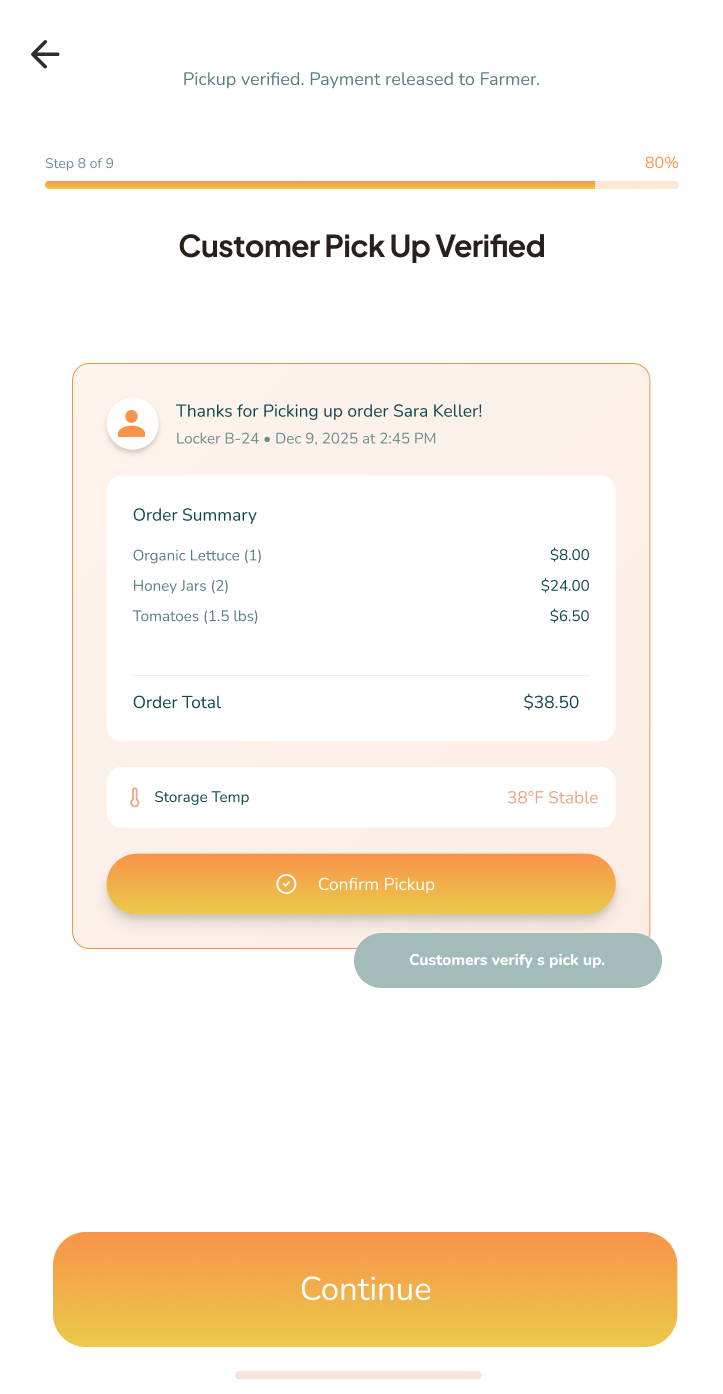
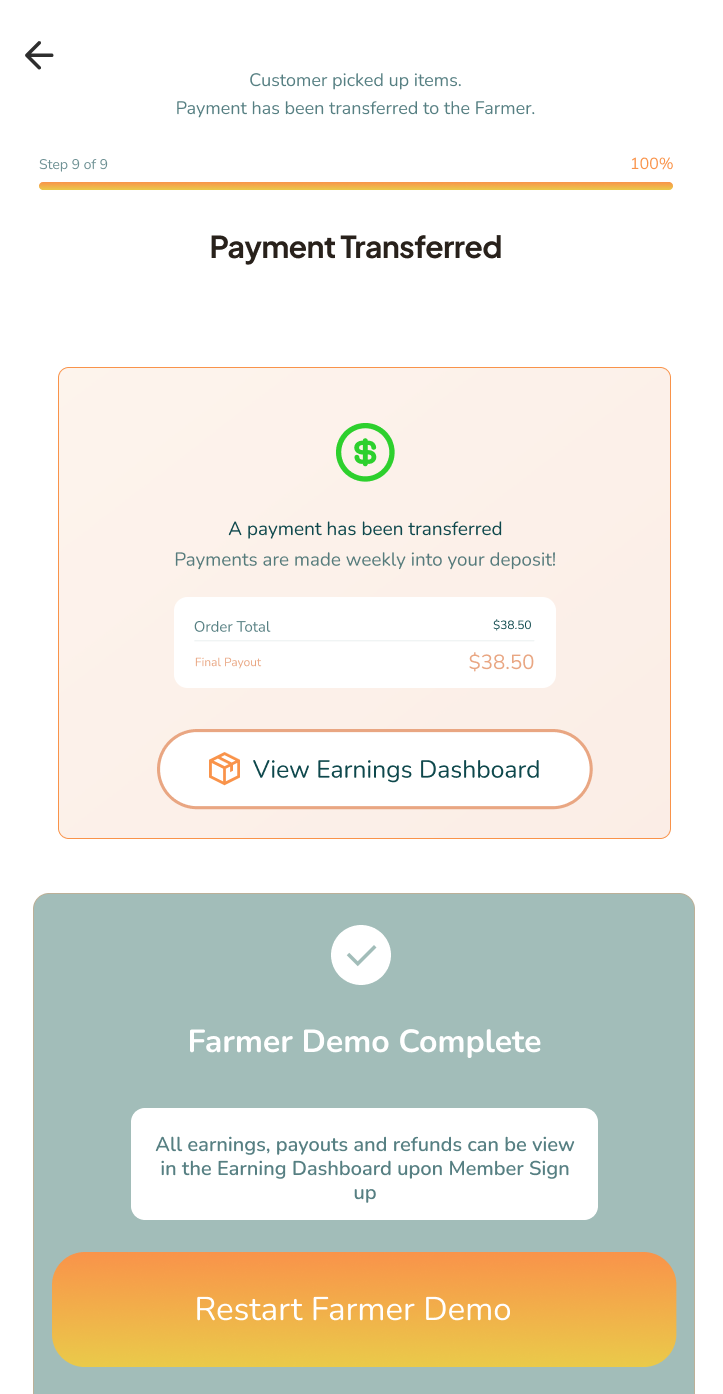
Browse local produce, order, deposit, and pick up from a BeltLine kiosk.

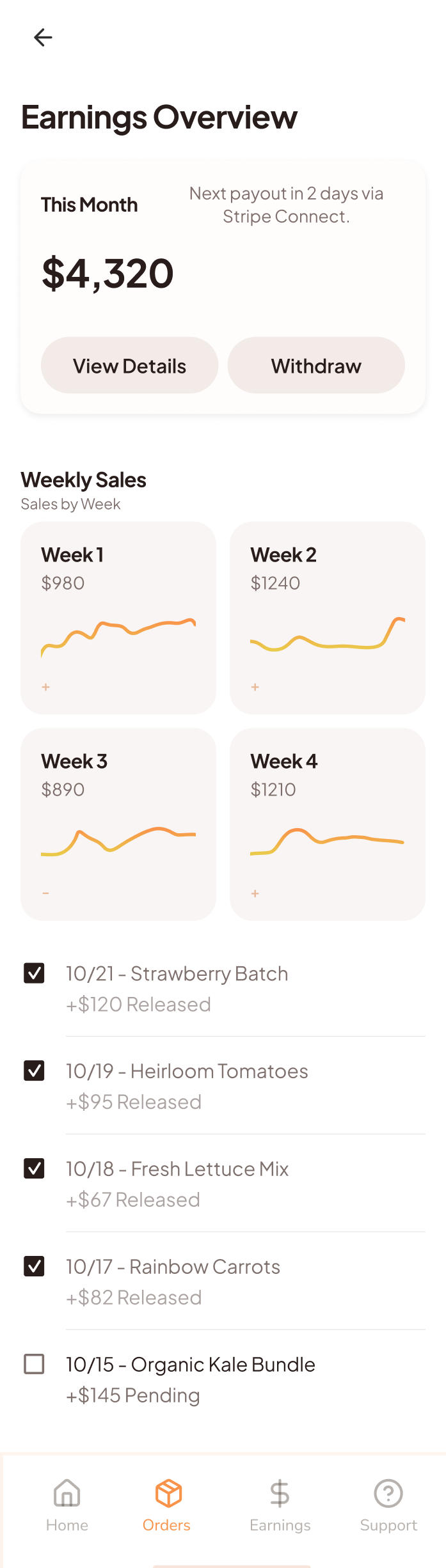
Vendor Dashboard

Manage listings, drop-offs, earnings, and support — for farmers and small vendors.

Farmer onboarding video preview

Farmer onboarding video

Open the prototype link below to view on mobile.

Farmer onboarding video

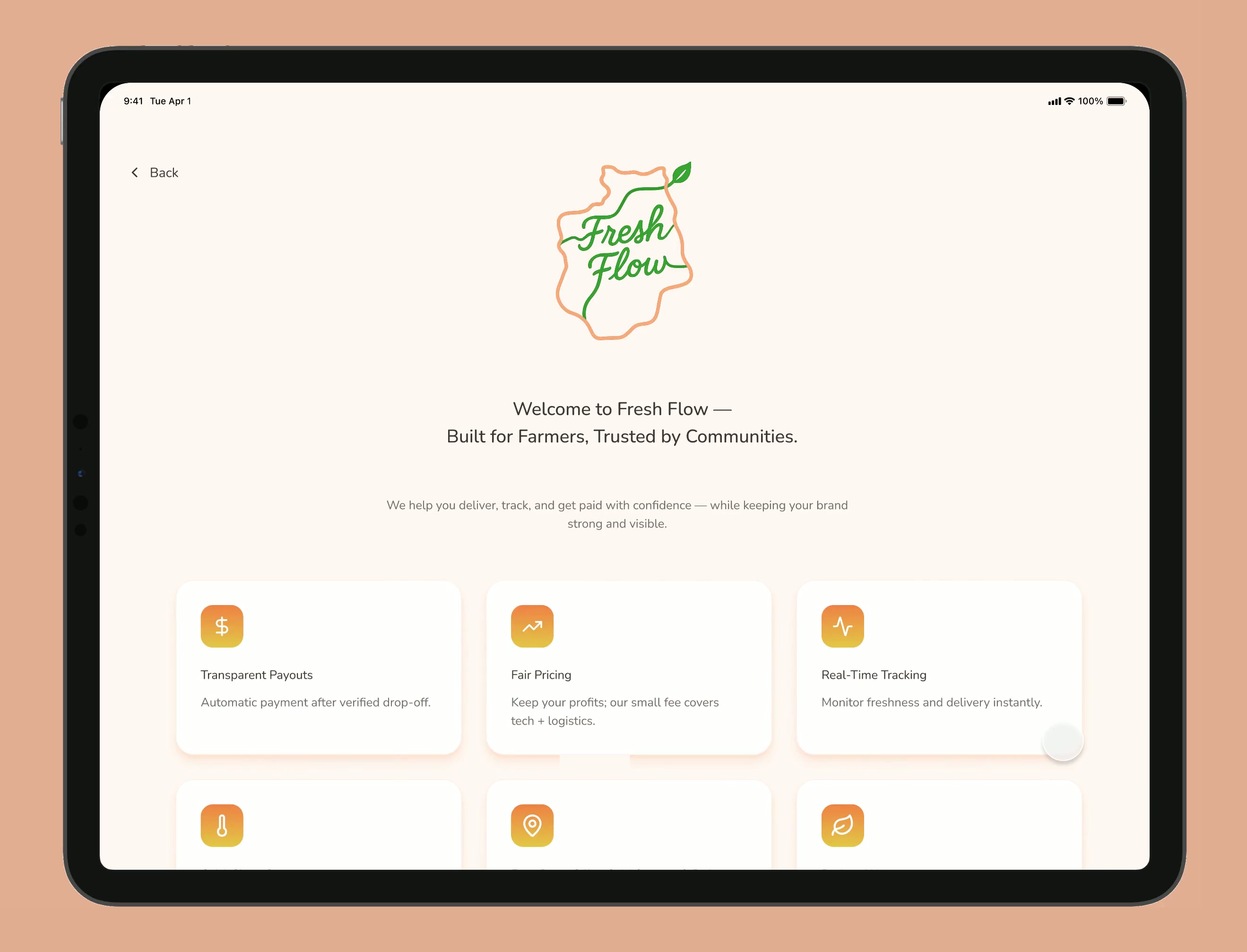
  • Introduces the Fresh Flow platform and farmer value proposition.
  • Collects farm profile, location, and contact details.
  • Lets farmers choose modular services like delivery, pickup, and logistics.
  • Sets payout preferences and verifies drop-off procedures.
  • Confirms scheduling and brand visibility before going live.
View interactive prototype

Round 3 — Validation

Did the redesign solve the problem?

Five moderated usability sessions evaluated whether the redesigned prototype resolved the usability issues identified in earlier testing. Participants completed key workflows with greater confidence and fewer questions around pricing, payouts, and service selection.

Validation Outcomes

What the redesign confirmed.

  • Pricing terminology understood
  • Split payouts were clear
  • Modular services reduced confusion
  • No-waste workflows increased trust

Validation Participants

Who we tested with.

Sean Joseph, Senior Software Engineer
Sean Joseph
Senior Software Engineer
Teallah Smith, Farmer & UX Professional
Teallah Smith
Farmer & UX Professional
Jason Hicks, Industrial Real Estate & Logistics
Jason Hicks
Industrial Real Estate & Logistics
Shane Bingham, Local Market Shopper
Shane Bingham
Local Market Shopper
Tate Tewksberry, Farmer
Tate Tewksberry
Farmer

Before vs. After

Measurable clarity gains.

Before

  • Pricing confusion
  • Unclear payouts
  • Too many service options
  • No inventory recovery visibility

After

  • Clear pricing
  • Split payouts understood
  • Easier service selection
  • Trusted no-waste process

Final Design Refinements

Information Architecture

  • Simplified pricing language
  • Clarified payment terminology

Operational Trust

  • Expanded QR verification
  • Improved no-waste visibility

Vendor Experience

  • Simplified onboarding
  • Reduced service complexity

Final Service Ecosystem

The validated Fresh Flow ecosystem.

Insights from two rounds of research and three rounds of usability testing shaped a connected service ecosystem that links producers, fulfillment, neighborhood pickup hubs, and consumers through one transparent logistics platform. The Atlanta BeltLine serves as the first pilot environment for validating the ecosystem before future expansion.

Connected Service Ecosystem

Fresh Flow connects consumers, producers, fulfillment, and neighborhood distribution through one coordinated service ecosystem. Both journeys rely on the same operational infrastructure while supporting different user needs.

Confidential

Fresh Flow System & Business Model

Confidential Business Strategy

The Fresh Flow System represents the proprietary operational framework behind the concept. While this portfolio showcases my UX strategy, research, branding, and product design process, the complete business model and system architecture are intentionally protected while the concept is under active development.

Additional details are available during confidential partnership, investor, or strategic discussions.

Request Access
Patent Pending

The Fresh Flow system — covering its kiosk pickup orchestration, verified cold-chain handoff, and farmer-first payout model — is currently under patent review.

Request the deck

Future Opportunities

Where Fresh Flow grows from here.

With the redesigned prototype validated, the next phase focuses on scaling the platform, deepening operational maturity, and expanding the pilot footprint.
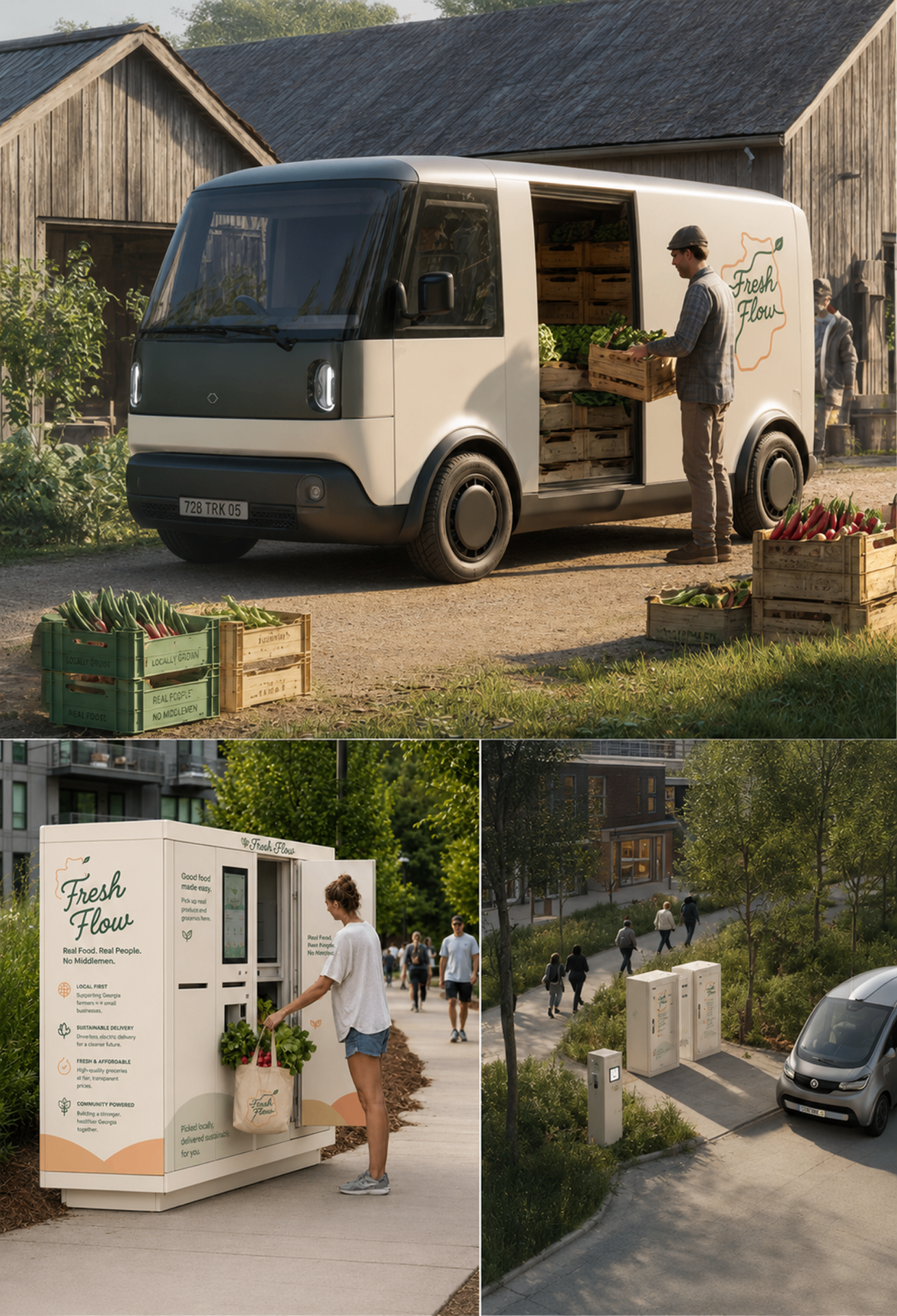
Fresh Flow future vision: autonomous delivery van, smart kiosk pickup, and neighborhood infrastructure connected along the Atlanta BeltLine.
A vision for Atlanta's connected local food ecosystem.

Scale

Expand BeltLine pilot locations

Operations

Improve dispute resolution workflows

Analytics

Build operational dashboards

Research

Continue usability testing at scale

Reflection

How my thinking evolved.

Fresh Flow reshaped how I define the scope of a design problem. The interfaces were only the surface — the real work was orchestrating a service that people, businesses, and operations could all trust.

Research changed the direction

Interviews pulled the problem out of the cart and into the food system around it. Following the evidence — not the original brief — is what made the work matter.

Design beyond the screen

The strongest decisions came from mapping the service, not styling screens. Kiosks, logistics, and vendor operations shaped the product as much as any UI.

User needs and business goals aren't a trade-off

Farmer margins, vendor throughput, and shopper trust reinforced each other once the service was designed as one system instead of three.

What I'm carrying forward

Lead with research, design the ecosystem before the interface, and treat every screen as a decision the business has to be able to deliver on.